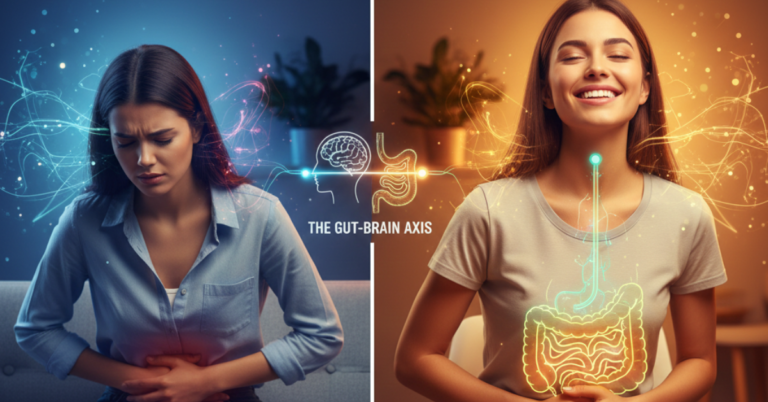

🧠 The Gut-Brain Connection: Why Your Stomach Might Be Running Your Mood
*** The information shared here is not medical or diagnostic advice. This article contains affiliate links, meaning I earn a commission if you make a purchase through them. ***
You know that feeling. You’re anxious about something — a presentation, a hard conversation, just life — and suddenly your stomach is in knots. Literally.
Or maybe it’s the other way around. You’ve been dealing with bloating, irregular digestion, or that heavy, sluggish feeling after meals for months. And somewhere along the way, you noticed your mood following the same pattern. Foggy. Irritable. Just… off.
Sound familiar? Yeah, me too.
Here’s the thing: that’s not a coincidence. Scientists call it the gut-brain connection — a real, physical communication line between your digestive system and your brain. And once you understand it, a lot of things about how you feel every day start to make sense.
Quick summary: Your gut and brain are connected through the vagus nerve, your immune system, and trillions of gut bacteria that produce neurotransmitters like serotonin. When your gut is out of balance, your brain feels it — and vice versa. Supporting your gut may genuinely support your mood, focus, and stress resilience.
😩 When Your Gut Talks, Your Brain Listens

Let’s be real for a second. Most of us grew up thinking of the stomach and the brain as two totally separate systems. One digests food, the other thinks thoughts. End of story.
But that’s just not how it works.
If you’ve ever noticed:
- Anxiety that shows up alongside bloating or stomach pain
- Brain fog that seems to follow a heavy or inflammatory meal
- Mood dips during flare-ups of digestive discomfort
- Getting “butterflies” or nausea before something stressful
- Feeling more irritable or low right after a stretch of poor digestion
…you’ve already experienced the gut-brain connection firsthand. You’re not imagining it. You’re not overreacting. Your body is just wired that way.
This matters because it affects more than digestion. It touches your energy, your focus, your relationships, even how resilient you feel under stress. When your gut is struggling, it’s not “just” a digestion problem — it can ripple into every part of your day.
Two feet below your brain, there’s a second nervous system running quietly in the background. Most people never think about it until something goes wrong.
🔬 What’s Actually Happening in There?
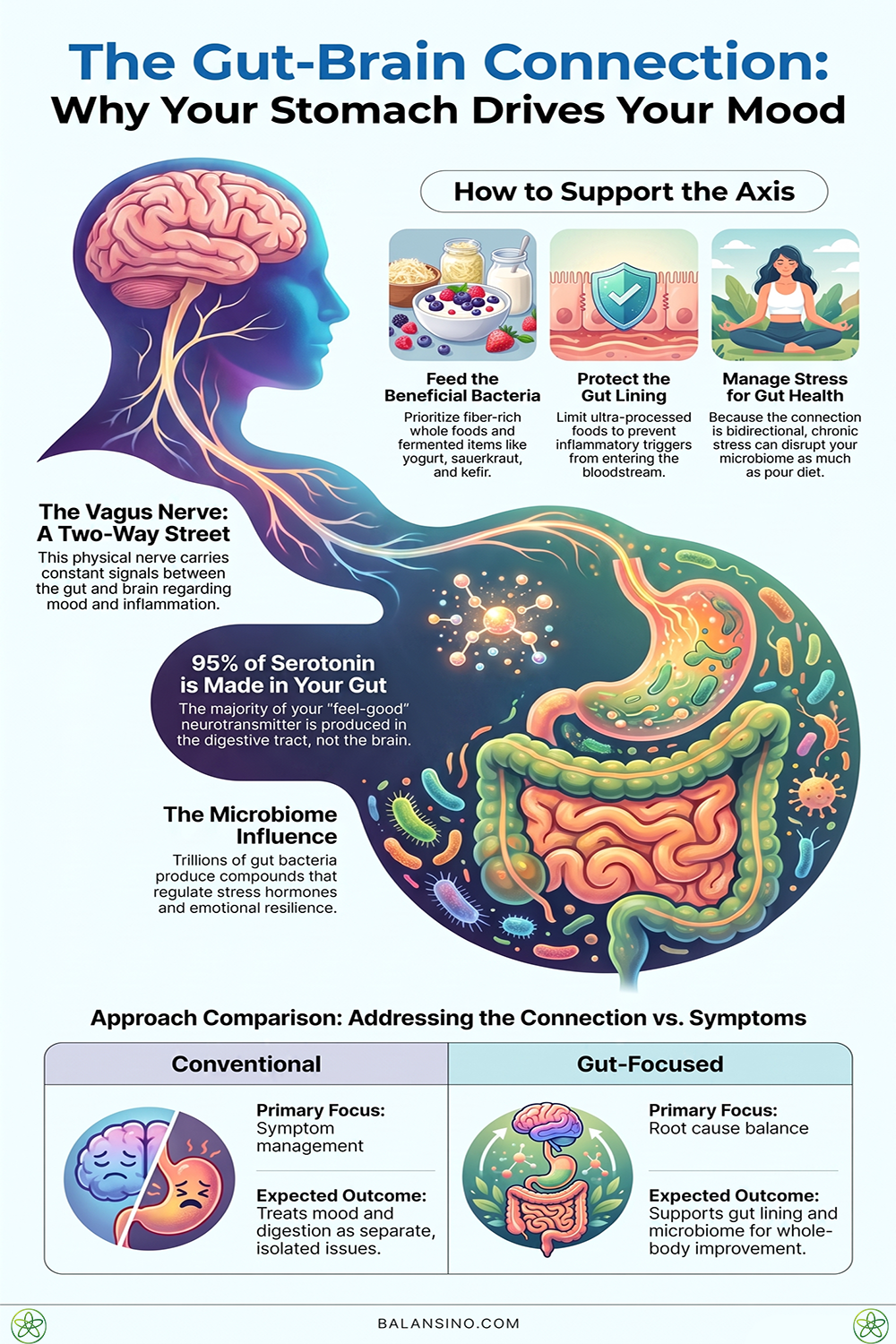
Your gut and brain are in constant conversation through a few key pathways:
The vagus nerve — Think of this as the physical phone line between your gut and your brain. It runs in both directions, carrying signals about inflammation, fullness, and — importantly — mood-related chemistry.
Serotonin production — Here’s a stat that surprises almost everyone: the vast majority of your body’s serotonin, the neurotransmitter tied to feelings of calm and wellbeing, is made in your gut, not your brain.
Your gut microbiome — The trillions of bacteria living in your digestive tract don’t just help break down food. They produce compounds that influence inflammation, stress hormones, and even how your brain responds to stress.
Gut lining integrity — When your gut lining is compromised (often described as “leaky gut”), it can allow inflammatory triggers into your bloodstream — and that inflammation doesn’t stay in your gut. It circulates.
This isn’t magic. It’s just biology — and it’s why “trust your gut” turns out to be more literal than anyone expected.
If you’re struggling with digestive discomfort that seems to be dragging your mood down with it, many people have found support through natural, gut-focused solutions. [Discover what’s helping thousands →]
⚖️ Two Ways to Approach This
| Approach | What It Targets | Realistic Expectations |
|---|---|---|
| Conventional (symptom-only) | Treats mood and digestion as separate issues | May offer relief, but misses the root connection |
| Gut-focused approach | Supports gut lining, microbiome balance, and inflammation together | Gradual, whole-body improvement — not an overnight fix |
Neither approach is “wrong.” But if you’ve tried managing your mood or your digestion in isolation and felt like something was still missing, this might be why.
🙋 Who Should Actually Pay Attention to This?
Not everyone needs to overhaul their relationship with their gut. But this connection tends to matter most if:
- You notice a clear pattern between digestive flare-ups and mood dips
- You’ve addressed stress or sleep and mood issues linger anyway
- You deal with bloating, irregularity, or discomfort on a regular basis
- You’ve tried mood-focused approaches without much change
- Brain fog shows up alongside digestive symptoms, not on its own
If two or three of these sound like you, the gut-brain connection is probably worth a closer look — not as a replacement for other support, but as a piece that’s often missing from the picture.
✅ How to Support Your Gut-Brain Axis, Practically
You don’t need to overhaul your entire life overnight. Small, consistent changes tend to matter more than perfect ones. Here’s where to start:
- Prioritize fiber-rich, whole foods — They feed the beneficial bacteria in your gut, which in turn support the compounds linked to calmer mood.
- Add fermented foods — Yogurt, kefir, sauerkraut, and kimchi introduce beneficial microbes naturally.
- Manage stress deliberately — Since the vagus nerve runs both directions, chronic stress can disrupt gut function just as much as gut issues can affect mood.
- Prioritize sleep — Your gut microbiome follows a rhythm too, and poor sleep disrupts it.
- Move your body regularly — Physical activity is linked to greater microbial diversity.
- Limit ultra-processed foods — They tend to feed less beneficial bacteria and may contribute to gut lining stress over time.
- Consider targeted gut support — For many people, food and lifestyle changes alone aren’t quite enough to rebuild gut lining integrity or rebalance a disrupted microbiome.
Progress here isn’t about perfection. It’s about giving your gut — and by extension, your brain — consistent support over time.
Want to support your body’s natural gut-brain balance? [Learn about this science-backed approach →]
❓ Common Questions About the Gut-Brain Connection
Does gut health really affect anxiety, or is that overstated? It’s not overstated, but it’s also not the whole story. Research links gut health to anxiety through inflammation and serotonin pathways — but stress, sleep, and life circumstances matter too. Think of your gut as one important piece of a bigger puzzle, not the whole answer.
How long does it take to notice a difference? This varies a lot by person. Some notice small digestive shifts within a few weeks of consistent changes. Mood-related changes, when they happen, tend to build more gradually — this is a marathon, not a sprint.
Can gut health issues cause anxiety, or does anxiety cause gut issues? Both, actually. The relationship is bidirectional — your gut can influence your brain, and your brain can influence your gut. That’s exactly why addressing just one side often falls short.
Your gut isn’t just processing your last meal — it’s actively shaping how you feel, think, and handle stress every single day. Supporting your gut may be one of the most overlooked ways to support your mental clarity and emotional balance long-term.
You’re not broken. Your gut and brain are just having a conversation — and it might be time to help them get on the same page.
🔬 Scientific Studies on the Topic
Disclaimer: This information is not medical advice. Always consult scientific research and your healthcare provider. Below are peer-reviewed studies that support the key points discussed:
1. Interaction of the Vagus Nerve and Serotonin in the Gut–Brain Axis
- Summary: Here’s the thing about serotonin — most of it isn’t even made in your brain. This 2025 review confirms that serotonin produced in your gut activates the vagus nerve, sending signals directly to brain regions that regulate mood, stress response, and emotional balance. The researchers also found that compounds made by your gut bacteria (short-chain fatty acids) actually boost this serotonin signaling. Plus, this pathway works both ways — so what happens in your gut genuinely reaches your brain, and not just metaphorically.
- Source: https://pmc.ncbi.nlm.nih.gov/articles/PMC11818468/
2. Effects of Prebiotics and Probiotics on Symptoms of Depression and Anxiety in Clinically Diagnosed Samples
- Summary: This 2025 meta-analysis pooled 23 randomized controlled trials with over 1,400 participants — and the results are worth paying attention to. Probiotics showed substantial reductions in depression symptoms and moderate reductions in anxiety symptoms in clinically diagnosed patients, in as little as 8 weeks. The researchers suggest that treating the gut microbiome alongside traditional mental health care holds real promise. That’s a big deal for anyone who’s felt like standard treatment alone wasn’t covering everything.
- Source: https://pmc.ncbi.nlm.nih.gov/articles/PMC12166186/
3. Gut Permeability and Cognitive Decline: A Pilot Investigation in the Northern Manhattan Study
- Summary: This human study looked at what happens when your gut lining becomes more permeable (“leaky gut”) over time. Researchers found that higher levels of a bacterial byproduct called LPS — which leaks through a compromised gut barrier — were linked to measurable cognitive decline over several years. The likely mechanism? Chronic low-grade inflammation traveling from gut to brain. It’s a strong reminder that gut lining health isn’t just about digestion — it’s about long-term brain health too.
- Source: https://pmc.ncbi.nlm.nih.gov/articles/PMC8186438/
Your gut isn’t just processing your last meal — it’s actively shaping how you feel, think, and handle stress every single day. Supporting your gut may be one of the most overlooked ways to support your mental clarity and emotional balance long-term.
Ready to take the next step in your gut-brain balance journey? [See how this natural solution can help →]
Written by @Balansino. Balansino Blog is based on decades of personal experience in health-related subjects—primarily autoimmune conditions, overweight/obesity, healthy nutrition and HEALTHY LIFESTYLE.