

💬 How to Set Boundaries Without Feeling Guilty
*** The information shared here is not medical or diagnostic advice. This article contains affiliate links, meaning I earn a commission if you make a purchase through them. ***
You know the moment. Someone asks you for something — your time, your energy, your Saturday — and before you’ve even thought it through, “sure, no problem” is already out of your mouth.
Meanwhile your actual answer was no.
Later you’re lying awake, replaying it, wondering why you can’t just say what you mean. And here’s the kicker: even imagining saying no makes your stomach drop. Like you’d be doing something wrong. Like you’d be a bad friend, a bad partner, a bad daughter, a bad employee — a bad person.
You’re not. But that feeling is real, and it’s exhausting.

😬 Why Saying No Feels Like a Crime
Let’s be real for a second: nobody teaches us how to set boundaries. We’re taught to be nice. To be helpful. To not “make a big deal” out of things. So somewhere along the way, your needs quietly moved to the bottom of the list — and staying there started to feel like the price of being a good person.
That’s not a character flaw. It’s a pattern.
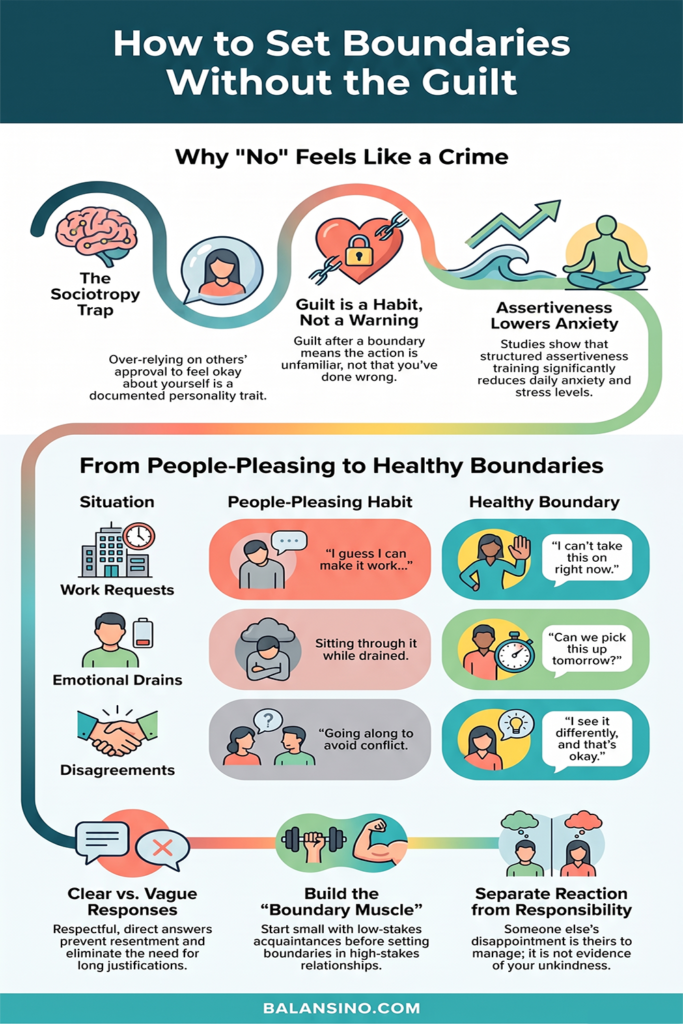
Psychologists have a name for the personality style behind it: sociotropy — an overreliance on other people’s approval to feel okay about yourself. If that’s you, saying no doesn’t just feel uncomfortable. It feels like risking the relationship itself.
And the cost adds up. Overcommitting. Resentment you can’t quite explain. Being “fine” on the outside while quietly running on empty. Sound familiar? Yeah, me too.
🧠 The Guilt Isn’t a Warning Sign. It’s a Habit.
Here’s the part that changes everything once it clicks: guilt after a boundary doesn’t mean you did something wrong. It means you did something unfamiliar.
Your nervous system doesn’t know the difference between “I disappointed someone” and “I hurt someone.” Both trigger the same alarm. So when you set a limit for the first time, your brain reacts like you’ve broken a rule — even when the only rule you broke was the unspoken one that said your needs come last.
This isn’t magic to fix in one afternoon. But it is learnable. The guilt fades with repetition, not with waiting for it to feel comfortable first.
Some people get there through therapy. Some through journaling and small, deliberate practice. And some find that the real obstacle isn’t the words they say — it’s the old mental script running underneath, the one convinced that being loved and being agreeable are the same thing. If that script is the actual block, working on the thinking pattern itself — not just memorizing new phrases — tends to be what finally moves the needle. If old thought patterns keep pulling you back into people-pleasing mode no matter how many scripts you memorize, this might be worth a look →
🤝 What a Healthy Boundary Actually Sounds Like
Boundaries don’t have to be dramatic. They’re not walls. They’re just information — telling people what works for you and what doesn’t, kindly and clearly.
Here’s what that shift can look like in practice:
| Situation | People-Pleasing Response | Healthy Boundary |
|---|---|---|
| Asked to cover a shift you can’t take | “Um, okay, I guess I can make it work…” | “I can’t take this one — hope you find someone!” |
| Family pressuring you into a visit | Going anyway, resentful the whole time | “I can’t make it this time, but let’s plan something soon” |
| Friend venting for the third hour | Sitting through it, drained | “I want to be there for you — can we pick this up tomorrow? I’m running low right now” |
| Partner expecting you to always agree | Going along to avoid conflict | “I see it differently, and that’s okay — we can still figure this out” |
Notice something? None of these are harsh. None of them require an essay of justification. A clear, respectful response is enough. You don’t owe anyone a defense for having limits.
🛠️ 5 Ways to Practice This Without the Guilt Spiral
1. Get specific before you speak. Vague boundaries crumble under pressure. Know exactly what you’re saying yes and no to before the conversation happens.
2. Start small. Don’t test this out on the highest-stakes relationship in your life first. Practice with the coworker, the acquaintance, the low-cost situations — build the muscle before you need it for something big.
3. Skip the over-explaining. “I can’t do that right now” is a complete sentence. Long justifications often just invite more negotiation.
4. Expect the discomfort — and let it pass. It will feel weird the first few times. That’s not proof you’re doing it wrong. It’s proof you’re doing something new.
5. Separate their reaction from your responsibility. If someone’s upset about your boundary, that’s theirs to sit with. Their disappointment isn’t evidence that you did something unkind.
If none of that sticks no matter how hard you try — if the guilt keeps winning even when you know logically you’re allowed to have limits — it might not be a “boundaries” problem at all. It might be a deeper mindset pattern worth actually working through, not just white-knuckling past. This program walks through exactly that — how belief patterns quietly sabotage relationships and confidence, and how to start shifting them →
🌱 Progress, Not Perfection
You’re not going to get this right every time. You’ll still say yes when you meant no sometimes. You’ll still feel that old flicker of guilt long after you “should” have moved past it.
That’s okay. Boundaries aren’t a personality transplant. They’re a practice.
And every single time you hold one — even a small one — you’re quietly telling yourself something that matters: my needs are allowed to exist too.
Not someday. Starting with the next “no” you actually mean.
If you want a more structured way to work through the underlying thought patterns that keep pulling you back into people-pleasing — not just tips, but a real mental framework — this is worth exploring →
🔬 Scientific Studies on the Topic
Disclaimer: This information is not medical advice. Always consult scientific research and your healthcare provider. Below are peer-reviewed studies that support the key points discussed:
1. Sociotropy, Autonomy and Emotional Symptoms in Patients with Major Depression or Generalized Anxiety
- Summary: Here’s the thing about people-pleasing — it’s not just a habit, it’s a measurable personality trait called sociotropy, and researchers found it’s directly linked to anxiety and depressive symptoms. The connection runs through rumination — that looping, “did I upset them?” style of overthinking that happens after you say no (or don’t). The study found this pattern held up across 279 patients, regardless of whether their main struggle was depression or anxiety. Basically: your guilt spiral after setting a boundary isn’t random. It’s a documented psychological chain reaction.
- Source: https://pmc.ncbi.nlm.nih.gov/articles/PMC7459840/
2. The Effectiveness of Assertiveness Training on the Levels of Stress, Anxiety, and Depression of High School Students
- Summary: Here’s the encouraging part — assertiveness isn’t fixed, it’s trainable. In this study of 126 students, the group that went through structured assertiveness training showed significantly lower anxiety scores than the control group just two months later. Depression scores dropped too, even if that shift wasn’t quite as sharp. The takeaway: practicing how to say what you mean, on purpose, has a measurable effect on how anxious you feel day to day — not just how “confident” you sound.
- Source: https://pubmed.ncbi.nlm.nih.gov/26889390/
3. The Effectiveness of an Assertiveness Training Program on Psychological Wellbeing and Work Engagement Among Novice Nurses
- Summary: This one’s for anyone who thinks boundaries are just a “personal life” thing — turns out they matter just as much at work. After going through an assertiveness training program, nurses showed a significant jump in psychological wellbeing scores, and the improvement in assertiveness directly correlated with how well they were doing emotionally. Translation: learning to speak up for your needs doesn’t just protect your relationships. It protects your mental health, full stop.
- Source: https://pubmed.ncbi.nlm.nih.gov/32034762/
Bottom line? The guilt you feel when you set a boundary isn’t a character flaw — it’s a well-documented, well-studied pattern. And the good news is: it’s exactly as trainable as the research suggests.
Written by @Balansino. Balansino Blog is based on decades of personal experience in health-related subjects—primarily autoimmune conditions, overweight/obesity, healthy nutrition and HEALTHY LIFESTYLE.