😴 How to Sleep Better at Night Naturally: All You Want to Know About Good Sleeping
*** The information shared here is not medical or diagnostic advice. This article contains affiliate links, meaning I earn a commission if you make a purchase through them. ***
The 3 AM Wake-Up Call: Is This Your Nightly Reality?
You know that feeling don’t you?
It’s 2 AM, and again you find yourself lying in bed staring at the ceiling. Your mind won’t shut off. You have counted sheep, flipped your pillow to the cool side, and moved around a dozen times. In the meantime, your alarm is set for 6 AM, and you’re calculating how little sleep you are about to get. Again.
Tomorrow, you’ll drag yourself through the day, fueled by coffee, feeling foggy, irritable, and exhausted. Productivity will tank. Patience will wear thin. And worst of all, you know tonight will probably be the same story all over again.
If this sounds familiar, you are not alone. Millions are struggling with poor quality sleep, and it’s taking a toll on just about every area of their lives: from health, to relationships, work performance, and even their overall happiness.
But here’s the good news—you don’t have to embrace restless nights as your reality. There are some natural, science-backed ways to dramatically improve the quality of sleep sans sleeping pills or costly treatments.
🤯 Why Can’t You Sleep? Laying Out the Root Problem.
Before we get to solutions, let’s discuss why sleep has become so evasive for so many of us: our modern lifestyle is basically at war with our biology.
Your body has an internal clock called the circadian rhythm. Think of it like your body’s natural sleep-wake cycle. For thousands of years, this rhythm was in perfect sync with the sun. When it went dark outside, our bodies created melatonin, and we became sleepy. When the sun rose, we woke up naturally.
But today? We’re in front of artificial blue light from phones, tablets, and computers well into the night. We drink caffeine at 4 PM. We keep irregular schedules. And through it all, we maintain stress, overstimulation, and disconnection from natural rhythms.
The result of this is a confused circadian rhythm, a body that has no idea when it is time to sleep, and you are stuck in that no-good-rest cycle.
🛌 The Foundation: Creating Your Sleep Sanctuary
Let’s start with your bedroom. Right now, take a look around you. Is it cool, dark and quiet, or is the light streaming in, the electronics humming, and the clutter everywhere?
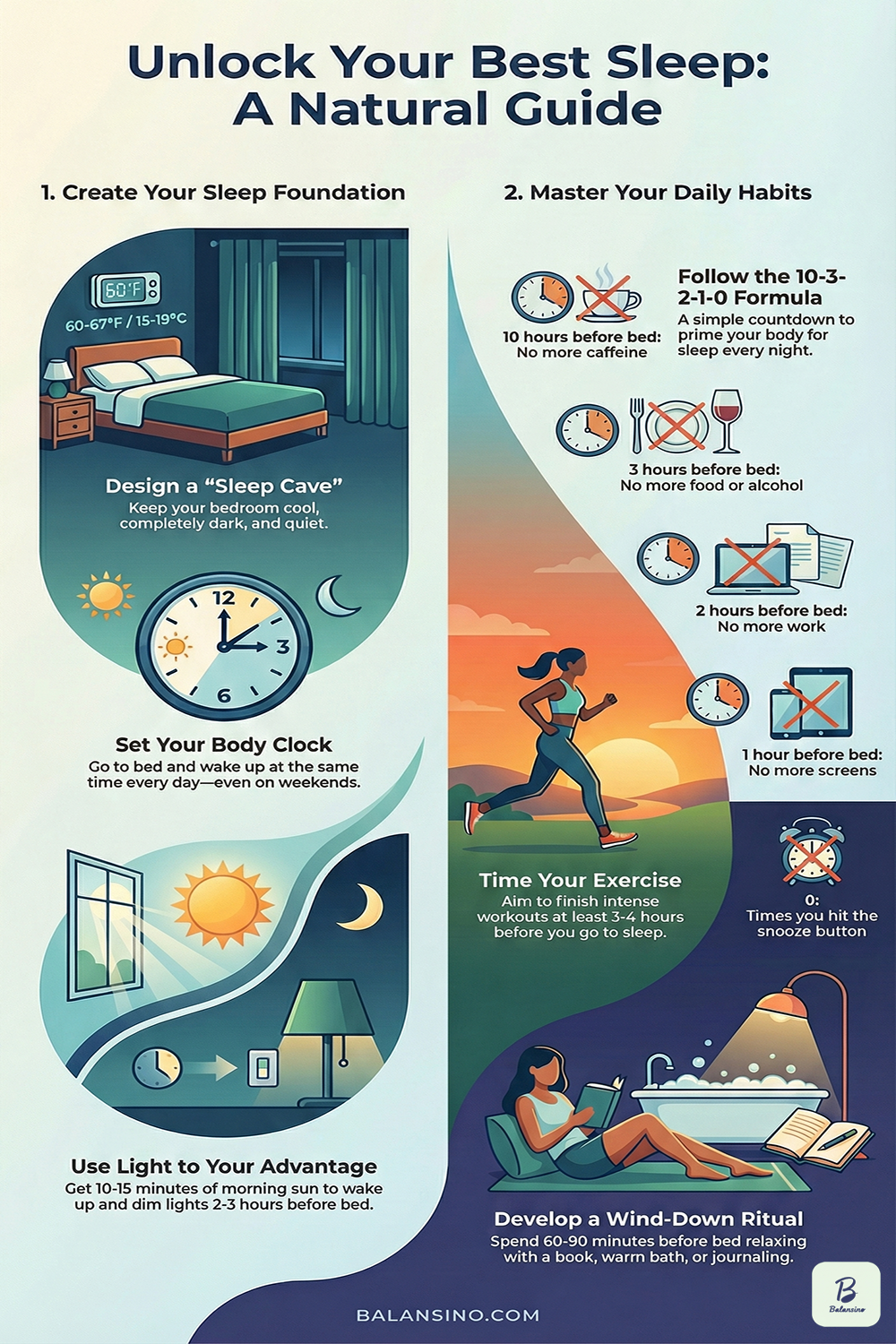
Your bedroom should be a cave: cool, dark, and quiet. This is not just a matter of preference; it’s biology. Your body temperature naturally decreases while you sleep, so a room between 60-67°F (15-19°C) helps that process along.
Darkness Matters
As little as a nightlight or even starlight coming in through the window can block production of melatonin, a sleep-promoting hormone. Consider investing in:
- Blackout curtains or a quality sleep mask.
- Cover or remove any electronics with LED lights.
- Your room should be so dark you can’t see your hand in front of your face.
Noise Control
If you live in a noisy area, consider a white noise machine or app. The constant sound masks disrupting noises that may wake you during lighter stages of sleep.
🕰️ Master Your Body Clock
Your circadian rhythm is strong, but it relies on consistency for it to function properly. That means retiring and rising at the same time each day, yes, on weekends too.
I know, I know, sleeping in on Saturday sounds great when you are exhausted. But those extra hours actually make your Monday morning harder because it shifts your rhythm. That is like giving yourself jet lag every single weekend.
Instead, choose a realistic sleep schedule and adhere to it. If you need to be up at 6 AM for work and you need 8 hours of sleep, then 10 PM becomes your target bedtime. Every single night.
Morning Sunlight is Key
Morning sunlight exposure is your secret magic ammunition here. Within 30 minutes of rising, take a 10- to 15-minute walk outside, or sit by a bright window. This resets your brain in an instant, basically saying, “It’s morning! Wake up!” and sets your internal clock for the rest of your day. And the counterpart to that in the evening? Dim the lights 2-3 hours before going to bed to signal to your body that sleep time will soon be upon it.
🛁 The Evening Wind-Down Ritual
You can’t go from 100 mph to sleep in five minutes. Your body needs a transition period—a wind-down ritual that signals it’s time to rest.
Start this well in advance of your bedtime target—basically, 60-90 minutes. Here’s what one might look like:
- 9:00 PM – Put away all screens. Yes, all of them. The blue light from devices suppresses melatonin up to 50%.
- 9:15 PM: Have a warm bath or shower. In this way, after getting out, your body temperature cools down and imitates the natural dip in temperature that happens during sleep, which makes you feel drowsy.
- 9:30 PM: Do something actually relaxing. Read an actual book (not on a backlit screen). Do some light stretches. Do some deep breathing. Journal about your day to clean your mind.
- Go to bed: 9:45 PM
The key to this is consistency. Your brain learns through patterns. Whenever you follow the same bedtime routine every night, your body starts preparing for sleep even before it hits the pillow.
☕ What You Eat and Drink Matters More than You Think
That afternoon coffee could be in sabotage mode when it came to sleep. Caffeine has a half-life of 5-6 hours, which means that half is still in your system that amount of time after imbibing. Have a cup of coffee at 4 PM and you will have a quarter of that caffeine still active at midnight.
- Establish a caffeine cutoff time—ideally well before 2 PM if this is a chemical to which you are particularly sensitive.
- Another sleep disruptor that people misunderstand is alcohol. Yes, it might make you drowsy initially, but it destroys sleep quality in the second half of the night, fragmenting your sleep and reducing REM sleep—the restorative kind.
- For food, try to avoid having a lot of big meals 2-3 hours before you are asleep. Your body should not work very hard digesting while trying to sleep. That being said, going to bed on an empty stomach is not good either. If you need something, have small snacks that are combined with complex carbs and protein, like whole grain toast with almond butter.
Many find the reinforcement of the body’s sleep-wake cycle, with the right approach, to actually make much difference. If you are seeking a natural way to work with your body’s rhythm rather than against it, consider exploring the solutions designed for this very purpose. Thousands have found this approach helpful in their journey to better sleep.
🤸 Timing Is Everything: Move Your Body at the Right Time
One of the most strong natural sleep remedies is, of course, exercise. Regular physical activity regulates your circadian rhythm, reduces stress and anxiety, and physically tires your body out in a healthy manner.
Timing is everything. Vigorous exercise raises your core body temperature and can increase energizing hormones like cortisol and adrenaline. Exercising too close to bedtime has actually been linked with poorer sleep.
- Aim to complete intense workouts at least 3-4 hours prior to bedtime. Morning or afternoon exercise gives the greatest sleep benefits.
- Gentle activities, like yoga, stretching, or a light, slow walk, can actually fit into your evening routine by helping you wind down.
- If you are sedentary now, take it easy. As little as 20 minutes of walking a day can positively affect sleep. When it comes to sleep, regularity trumps intensity.
🧠 Clearing the Mind: The Immensity of Stress, Anxiety, and Racing Thoughts
Let’s talk about the elephant in the bedroom: your mind.
You’ve perfected your sleep environment. You’ve established a routine. You’ve cut the caffeine. But when your head hits the pillow, your brain starts running through tomorrow’s to-do list, replaying today’s awkward conversation, and generally refusing to shut up.
That’s very common, and that’s where natural sleep strategies, most of them, fall short: you don’t have any tools to manage your mind.
Techniques to Calm the Mind:
- The Brain Dump: Keep a notebook by your bed. When worries or tasks come up, you write them down. This tells your brain, “It’s handled; we’ll deal with it tomorrow.” It sounds so obtuse, but it can be remarkably powerful.
- The 4-7-8 Breathing Technique: In through your nose for the count of 4, held for 7, out through your mouth for the count of 8, 4 times. This engages your parasympathetic nervous system—your “rest and digest” mode—and is an effective calming strategy against racing thoughts.
- Progressive Muscle Relaxation: This involves tensing, and then relaxing, muscle groups in a systematic manner, starting with your toes, working to your head, holding each for about 5 seconds. This releases physical tension you might not even realize you’re holding.
The 10-3-2-1-0 Formula:
- 10 hours before bedtime: No caffeine whatsoever
- 3 hours before bed: No more food or alcohol
- 2 hours before bed: stop working
- 1 hour before going to bed: Not more screen
- 0: Number of times hitting snooze (more on that next)
☀️ The Morning Matters Too
It’s true that the way you start your day is the way you end it, too. When your alarm goes off, try to avoid hitting the snooze button. That extra 10 minutes is not quality sleep; it’s just fragmenting your wake-up time and making you groggier.
Instead, place your alarm across the room so you have to physically get up to turn it off. Once you’re up, get that morning sunlight exposure we talked about earlier. This is crucial for setting your circadian rhythm for the entire day.
If you have tried different approaches and still have trouble sleeping consistently, you’re not alone. Many find that addressing their body’s natural rhythms from multiple angles—including targeted nutritional support—provides the breakthrough they’ve been looking for. Discover how others are finally achieving the consistent, restful sleep they deserve.
💤 What About Naps?
Naps can help or harm a good night’s sleep depending on how you use them. If you are sleeping well at night, a short 20-30 minute “power nap” in the early afternoon can help raise alertness and performance with no effect on nighttime sleep.
But if you are struggling with nighttime sleep, avoid the naps altogether—regardless of how tired you feel—so that daytime sleep pressure will be built up and help you to sleep better at night. It is going to be a little difficult for perhaps one or two weeks, but it does reset your pattern.
📉 The Sleep Debt Reality Check
The uncomfortable truth is: you can’t really “catch up” on sleep. If you shortchange yourself all week and then try to sleep 12 hours on Saturday, you might feel somewhat better, but you haven’t undone the damage of sleep deprivation.
It’s known as chronic sleep debt, a running tab of lost rest that just grows and keeps on affecting your physical health, mental clarity, immune system, and even your weight. The only realistic solution is consistent, adequate sleep night after night.
Most adults need 7-9 hours. Not 6. Not 5. Seven to nine hours. Every night.
🩺 When Nothing Seems to Work
If you have done these strategies constantly for 3-4 weeks and are still struggling a lot, then that is the time you start to consider that something deeper may be going on.
Some conditions, such as sleep apnea, restless leg syndrome, or chronic insomnia, may need professional evaluation. Do not be ashamed to seek help from a sleep specialist. But for most people, the natural strategies outlined here can make a huge difference.
🏆 Your Better Sleep Challenge in 30 Days
Real change requires consistency. Now, here’s your challenge:
- Week 1: The objective in week one is to establish a regular sleep schedule by going to bed and waking up at the same time each day, even on weekends. Also, morning sunlight: This helps regulate your circadian rhythms.
- Week 2: Incorporate wind-down bedtime routine, screen removal 60 minutes before bedtime.
- Week 3: Also, optimize the sleep environment—cooler temperature, darkness, quiet. If you consume it, stop caffeine after 2 PM.
- Week 4: Include regular physical activity and practice the mind-calm techniques.
Track your sleep quality on a scale of 1-10 each morning. You should see noticeable improvement by week 2 or 3, with continued gains as habits solidify.
🔚 The Bottom Line
Better sleep isn’t about finding a magic pill or perfect mattress. It’s about working in concert with your body’s natural biology, rather than in opposition to it. It’s about creating conditions to allow your body to do what it was designed to do: rest, repair, and rejuvenate.
Every intervention in this post is natural, evidence-based, and well within your sphere of control. You do not need costly treatments or prescriptions. You just need consistency, patience, and a commitment to prioritizing your sleep health.
Your body wants to sleep well. Your brain wants to sleep well. You’ve just been, unknowingly, short-circuiting the process with modern habits at cross purposes to ancient biology.
Start tonight. Take one or two of the strategies from this guide and put them into place. Add another tomorrow. And within a few weeks, you likely know what it will feel like to wake up truly refreshed: clear-headed, energetic, and ready to take on your day.
Want to take your sleep transformation to the next level? Because once these foundational strategies have been instituted, for many the natural supplementation of the body’s process accelerates their results. [Click here to learn about the natural sleep support system that’s helping thousands achieve deeper, more restorative sleep starting tonight]. Your journey to better sleep begins with a single decision—make tonight the night everything changes. Sleep tight; you deserve it.
🔬 Scientific Studies on the Topic
Disclaimer: The information shared here is not medical or diagnostic advice.
1. Sleep quality: An evolutionary concept analysis
- Summary: This concept analysis aims to clarify the meaning of sleep quality, which is defined as an individual’s self-satisfaction with all aspects of the sleep experience. It identifies four key attributes: sleep efficiency, sleep latency, sleep duration, and wake after sleep onset. Antecedents to sleep quality include physiological, psychological (stress, anxiety), and environmental factors. The analysis concludes that poor sleep quality significantly contributes to disease and adverse health outcomes, emphasizing the critical role of clinicians in promoting good sleep hygiene.
- Source: https://pubmed.ncbi.nlm.nih.gov/34610163/
2. Improving sleep quality leads to better mental health: A meta-analysis of randomised controlled trials
- Summary: This meta-analysis of 65 randomized controlled trials examined whether interventions that improve sleep quality also improve mental health. The results showed that improving sleep led to a significant medium-sized effect on composite mental health, depression, anxiety, and rumination, as well as significant small-to-medium effects on stress. Furthermore, a dose-response relationship was found, indicating that greater improvements in sleep quality led to greater improvements in mental health. The findings suggest a causal link between sleep and the experience of mental health difficulties.
- Source: https://pmc.ncbi.nlm.nih.gov/articles/PMC8651630/
3. The association between sleep quality and quality of life: a population-based study
- Summary: This large population-based study ($N=225,541$) investigated the association between sleep quality and quality of life (QoL). It found that poor sleep quality was significantly associated with impaired QoL, resulting in lower index scores. Participants with poor sleep quality were more likely to report problems with physical activity, self-control, daily activity, pain, and anxiety/depression (with the highest odds ratio observed for anxiety/depression problems). The study concludes that poor sleep quality impairs QoL, especially when anxiety/depression issues are present.
- Source: https://pubmed.ncbi.nlm.nih.gov/34147026/
These links offer strong evidence from systematic reviews and large population studies regarding the causal and critical link between sleep quality and overall well-being. The findings consistently emphasize that improving sleep is a highly effective, independent strategy for significantly enhancing both mental health and quality of life.
Want to take your sleep transformation to the next level? Because once these foundational strategies have been instituted, for many the natural supplementation of the body’s process accelerates their results. [Click here to learn about the natural sleep support system that’s helping thousands achieve deeper, more restorative sleep starting tonight]. Your journey to better sleep begins with a single decision—make tonight the night everything changes. Sleep tight; you deserve it.
Written by @Balansino. Balansino Blog is based on decades of personal experience in health-related subjects—primarily autoimmune conditions, overweight/obesity, healthy nutrition and HEALTHY LIFESTYLE.