😴 How to Fall Asleep Instantly: A Guide for the Desperately Tired
*** The information shared here is not medical or diagnostic advice. This article contains affiliate links, meaning I earn a commission if you make a purchase through them. ***
It’s 2:47 AM. Again.
You tried counting sheep. You flipped your pillow to the cold side at least twelve times. You’ve scrolled through your phone—though well knowing you shouldn’t have, adjusted the thermostat, and stared at the ceiling so long you’ve memorized every shadow and texture up there.
Sound familiar?
If you are reading this right now, chances are you are exhausted. Not just tired—exhausted. You know, the kind of deep pain that seeps right through to your bones, making everything all the more difficult. Your concentration at work suffers. Your patience grows thin. The smallest things seem like mountain-climbing tasks. And yet when finally your head goes down toward the pillow each night, sleep just doesn’t seem to come.
You are not alone. Night after night, millions of people lie awake, wanting to fall asleep instantly, yet feeling like their brain has other plans. It’s profoundly frustrating. Anxiety about not sleeping further tips the scales against sleep, turning this into a self-perpetuating nightmare that seems impossible to break out of.
But it’s not all doom and gloom—because there are real, tangible remedies that might just get you to sleep a little faster tonight.
Let’s go ahead and talk about what is actually happening, and how to fix it.
❓ Why You Can’t Fall Asleep—And Why It’s Not Your Fault
Your lack of ability to fall asleep instantly is not a willpower issue. It is not because you are doing something wrong, but because you’re somehow broken. Sleep is a remedial biological process, and modern life has pretty much declared war on it.
Think about it: our ancestors did not have any blue light screens, 24-hour news cycles, or the ability to work from bed. Their bodies naturally got into sync with the sun: when it got dark, automatically, some biological processes kicked in. Melatonin levels rose. Body temperature dropped slightly. The brain started its natural sequence of wind-down.
Your body craves this, too. It’s hardwired for it.
But then we get in the way. Artificial light fools your brain into thinking it’s still daytime. Stress maintains high levels of cortisol at a time when those levels should be lowered. Caffeine from that afternoon coffee is still in your system hours later. Your bedroom is too hot. Your head is furiously racing over tomorrow’s to-do list.
Each one of these factors acts like a roadblock on your path to sleep. Remove enough roadblocks, and all of a sudden it becomes significantly easier to fall asleep.
✨ The Foundation: Setting the Condition for Instant Sleep
Before we dive into specific techniques, let’s establish something important: you can’t force sleep. The harder you try to fall asleep, the more elusive it becomes. It’s like trying to force yourself to be spontaneous—the effort defeats the purpose.
Instead, what you’re doing is creating the conditions most conducive to allow sleep to occur naturally. Think of it as gardening: you can’t make a flower grow, but you can give it the right soil, water, and sunlight. Sleep is the same way.
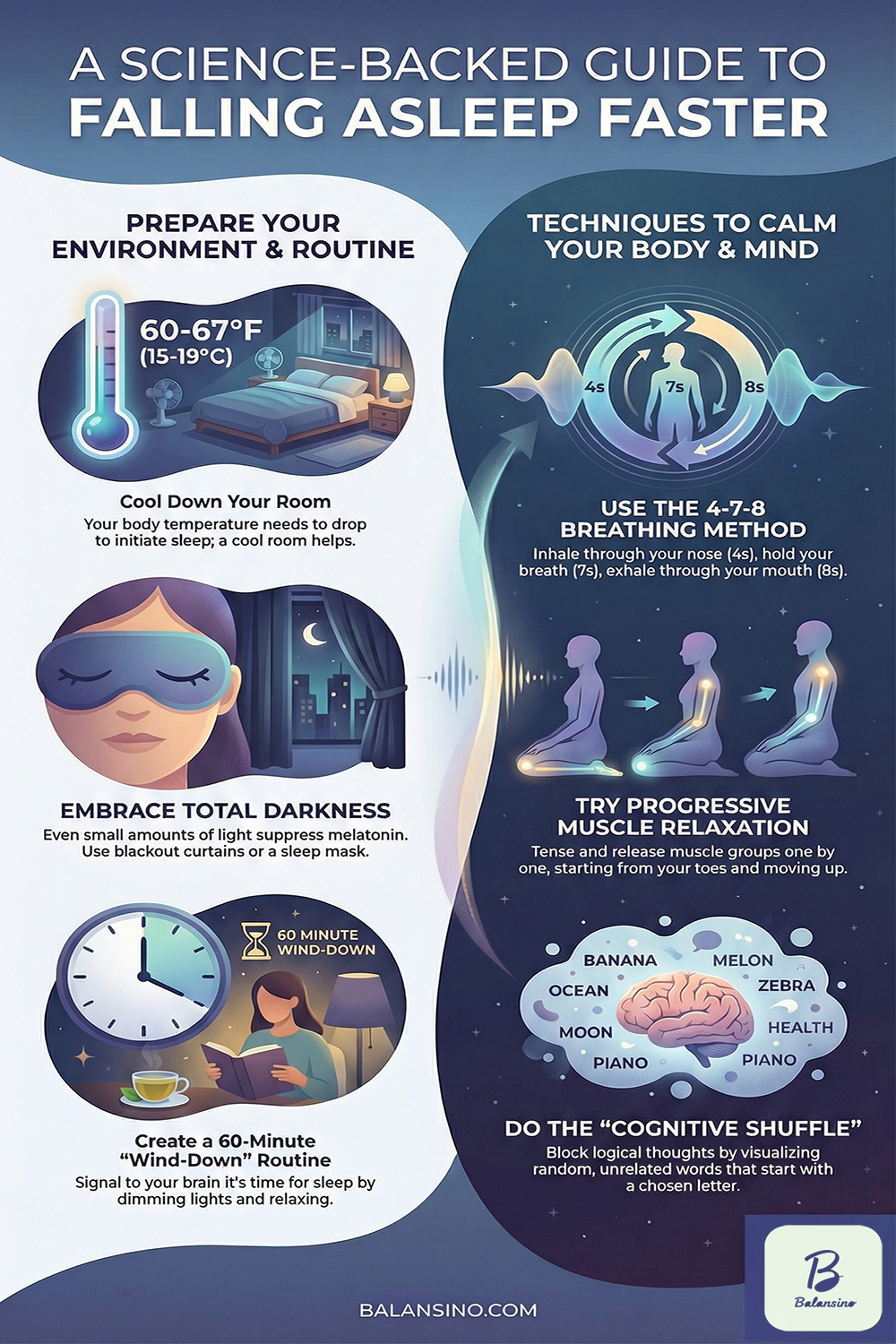
- Temperature is more important than you think. Your body needs to drop about 2-3 degrees Fahrenheit to fall asleep, which is why you naturally feel sleepy in a cool room. If your bedroom feels warm, then your body’s fighting an uphill battle. Aim for somewhere between 60-67 degrees Fahrenheit (15-19°C). Yes, that might feel chilly at first, but under covers, it’s perfect.
- Darkness is non-negotiable. It suppresses melatonin production even in tiny amounts. That little LED on your phone charger? It counts. The streetlight coming through your curtains? Counts too. Consider blackout curtains or a sleep mask. Your bedroom should be dark enough that you can’t see your hand in front of your face.
- Sound can make or break your sleep. For some people, complete silence works, while others need that gentle background noise to mask disruptive sounds. This is where white noise machines, fans, or nature sounds come in handy. The trick is consistency—your brain learns to associate certain sounds with sleep time.
🔬 Science-Backed Ways to Fall Asleep Fast
Now, let’s get into actual methods you can use tonight.
The 4-7-8 Breathing Technique works amazingly well for lots of people. Here’s how it goes:
- Breathe out completely through your mouth.
- Now, with your mouth closed, quietly breathe in through your nose to the count of 4.
- Hold your breath to the count of 7.
- Breathe out through your mouth to the count of 8 completely.
- Do this three more times.
This works because it literally slows you down. The long exhale triggers your parasympathetic nervous system—your body’s “rest and digest” mode. It’s physiologically hard to be anxious while breathing this way.
This progressive muscle relaxation helps release physical tension you might not even realize you’re holding. Start with your toes. Tense them for 5 seconds, then release. Feel the difference. Move up to your calves, then thighs, then stomach, and so on until you’ve worked through your entire body. Many people fall asleep before finishing this exercise.
The Cognitive Shuffle is one of the newer techniques, and it’s surprisingly effective. Your brain tries to stay awake because it is solving problems or following logical lines of thought. The cognitive shuffle scrambles this. Choose a random word—say, “bedtime.” Now, think of random words that begin with each of those letters.
- B: banana, butterfly, backpack.
- E: elephant, envelope.
- And so on.
The randomness blocks your brain’s tendency toward productive thinking, allowing sleep to creep in.
What about the support of natural sleep?
Addressing the deeper factors affecting sleep patterns often makes quite a difference for many people. Your body, in fact, manufactures certain chemicals to help you fall asleep naturally, but these may be hampered by a number of factors, including stress, age, diet, and lifestyle.
Others find that their normal sleep patterns become more consistent if they support their body’s natural sleep mechanisms with targeted nutritional approaches. This is not about forcing sleep, but giving your body what it needs to regulate its natural rhythms more effectively.
“Learn about a natural method that works in harmony with your body’s sleep cycles →”
It’s about finding solutions that work with your body’s natural biology, not against it. By the time your body has everything it needs to nutritionally support optimal sleep function, you might find yourself falling asleep a whole lot easier and more consistently.
🕒 The Pre-Sleep Routine That Changes Everything
Here’s what most people get wrong: they think they can go from full-speed productivity to instant sleep in five minutes. Your body doesn’t work that way. You need a runway, not a cliff.
Begin to wind down no less than 60 minutes prior to bedtime. This doesn’t mean lying in bed staring at the ceiling for an hour. It means gradually shifting gears.
- 60 minutes before bedtime: Do not work or stress over anything. Dim the lights in your house to show your brain that night is approaching. If you have to use screens, at least use blue light filters or night mode.
- 45 minutes before bedtime: Engage in truly relaxing behavior. Read something fun, but not too stimulating. Take a warm bath or shower. The drop in temperature after you get out actually helps begin the sleep process. Write in a journal if there are thoughts bouncing around. It helps to get them out so you can clear your mind.
- 30 minutes before bed: Do your nighttime hygiene routine. Brush your teeth, wash your face, whatever your routine involves. Make it consistent. Your brain loves patterns and will start associating these activities with sleep time.
- 15 minutes to bedtime: Final preparation. Set your room to the best sleep temperature. Make the room dark. Put on your sleeping attire. Perhaps do some light stretching or the 4-7-8 breathing.
- Bed: This is just for sleeping. Not for scrolling, not for watching TV, and not for work. It should be strongly connected with sleep in your brain.
🧠 The Mind Game: Quieting the Mental Chatter
Your racing thoughts are probably the biggest obstacle between you and instant sleep. That’s normal. The moment you lie down, your brain suddenly remembers seventeen things that you forgot to do and starts planning conversations you might have next week.
Try this trick in your mind: you’re watching your thoughts, but they’re like clouds in the sky. You notice them, but you don’t grasp them. A thought about tomorrow’s meeting floats by—okay, there it goes. A worry about that email—yep, floating on past. You’re not suppressing the thoughts or fighting them. You’re just not engaging with them.
This takes practice. Your brain will resist at first. It wants to solve problems and plan things. That’s its job. But sleep time isn’t problem-solving time. Gently, persistently, keep returning to the image of thoughts as clouds. Just passing by.
Another tactic is the “worst-case scenario” technique. Oftentimes, anxiety runs through our minds and keeps us awake. So follow the anxious thought to its logical conclusion. “What if I’m tired at work tomorrow?” Okay, what if you are? “I might not perform at my best.” And then what? “My boss might notice.” And then? Keep going until you reach the actual worst-case scenario. Usually, it’s not that bad. This often deflates the anxiety enough to allow sleep.
🥗 Sleep nutrition: The nutritional foundation of good sleep
What you put in your body, and when, are larger factors in sleep than many people realize. Want that afternoon coffee at 3 PM? It’s still awake and well in your system when bedtime rolls around. That heavy meal two hours prior to bed? Your body is working on digestion when it should be sleeping.
- Timing is everything. Try to finish eating at least 3 hours before bed. If you must have a light snack, keep it small and sleep-friendly. A handful of almonds or a banana won’t sabotage your sleep the same way pizza will.
- What matters, too, is what you eat. Food containing magnesium, such as leafy greens, seeds, and nuts, serves to underpin good sleep. Foods that contain tryptophan, such as turkey, milk, and eggs, provide building blocks for compounds in your brain involved in promoting sleep.
- What to avoid: Obviously, caffeine, but also be careful with alcohol. Yes, alcohol makes you drowsy initially, but it severely disrupts sleep quality later in the night. You might fall asleep quicker but wake up at 3 AM wide awake.
Unfortunately, many people do not realize that their body may be deficient in certain critical nutrients that facilitate the natural production of sleep-promoting compounds. In fact, once the body has an optimum level of those particular nutrients it requires to maintain healthy sleep cycles, the quality and pattern of sleep can naturally improve.
“Learn how you can get targeted nutritional support to optimize your natural sleep cycles →”
These might not be overnight fixes that support your body’s nutritional foundation, but many people find gradual improvements in ease of falling asleep and morning restedness.
😟 When Anxiety and Stress Won’t Let Go
Sometimes the problem isn’t physical, but a purely mental and emotional one. Stress and anxiety kill sleep. Stress turns on your stress response, and your body is literally designed to stay alert, which is absolutely opposite of what you need when trying to catch some shut-eye.
If this resonates, you want to go to the root cause: therapy, meditation apps, or stress management techniques during the day. Exercise is surprisingly effective at reducing stress hormones and promoting better sleep later on.
But for now, tonight, when you’re lying there stressed: try the body scan technique. You transfer your attention to each part of your body in your mind, starting with the toes and continuing upwards. Observe sensation without judgment. Your left foot—what does it feel like? Your right ankle? And this, in turn, anchors you in the present moment and stops the stress spiral.
🚶 Movement and Light: Daytime Factors
But here’s what most instant-fall-asleep articles don’t tell you: the stuff you do during the day matters as much as the stuff you do at night.
- Get some early morning sunlight exposure. This sets your circadian rhythm. Even 10-15 minutes of natural light in the morning tells your body that it is daytime, and that, in turn tells it when nighttime is.
- Move your body. Exercise is one of the strongest sleep promoters, but timing is everything. Strenuous exercise within a few hours of bedtime can be arousing. Try to finish vigorous exercise a few hours before bedtime so your body has time to wind down. Gentle stretching or yoga in the evening is okay, and can even help promote sleep.
- Be consistent. Your body loves routine. Try to go to bed and wake up at the same time every day, yes, even on weekends. This consistency reinforces your natural circadian rhythms.
✅ Putting It All Together
The idea of falling asleep isn’t just about finding one magic trick to make that happen; it’s about crafting an all-inclusive approach that deals with each one of those factors that keep you awake.
Start with the low-hanging fruit: fix your sleep environment. Make it dark, cool, and quiet. Establish a consistent wind-down routine. Practice the breathing techniques. Address the daytime factors like light exposure and exercise.
Then begin adding in the deeper strategies: work on stress management, optimize your nutrition for sleep, consider if targeted nutritional support could allow the body’s processes for sleep to function optimally.
Remember, consistency is everything. You may not fall asleep instantly on night one. But with due consistency—these strategies for a week, two weeks, a month—your body will start responding. Sleeping will get much easier and natural.
🚀 Your Sleep Transformation Starts Tonight
The exhaustion you feel right now doesn’t have to be your permanent reality. You are simply not doomed to endless nights staring at the ceiling and anxiety building as the hours tick by. Better sleep is completely possible for you.
Start with the strategies below tonight. Choose two or three that feel most resonant for you. Perhaps it’s the 4-7-8 breathing and creating a darker room. Perhaps it is making a wind-down routine and taking a look at your nutritional foundation.
Most people find that giving the body’s natural mechanisms supportive nutrition—in a comprehensive sense—provides the missing piece they have been searching for. When combined with the behavioral and environmental strategies we’ve discussed, the results can be transformative.
Better sleep is a journey that begins with a single decision: the decision that you deserve rest. You deserve to fall asleep easily and wake up feeling genuinely refreshed. You deserve nights without anxiety and mornings without grogginess.
That future is within our grasp. Let us move toward it tonight.
🔬 Scientific Studies on the Topic
Disclaimer: The information shared here is not medical or diagnostic advice.
1. Sleep quality: An evolutionary concept analysis
- Summary: This concept analysis aims to clarify the meaning of sleep quality, which is defined as an individual’s self-satisfaction with all aspects of the sleep experience. It identifies four key attributes: sleep efficiency, sleep latency, sleep duration, and wake after sleep onset. Antecedents to sleep quality include physiological, psychological (stress, anxiety), and environmental factors. The analysis concludes that poor sleep quality significantly contributes to disease and adverse health outcomes, emphasizing the critical role of clinicians in promoting good sleep hygiene.
- Source: https://pubmed.ncbi.nlm.nih.gov/34610163/
2. Improving sleep quality leads to better mental health: A meta-analysis of randomised controlled trials
- Summary: This meta-analysis of 65 randomized controlled trials examined whether interventions that improve sleep quality also improve mental health. The results showed that improving sleep led to a significant medium-sized effect on composite mental health, depression, anxiety, and rumination, as well as significant small-to-medium effects on stress. Furthermore, a dose-response relationship was found, indicating that greater improvements in sleep quality led to greater improvements in mental health. The findings suggest a causal link between sleep and the experience of mental health difficulties.
- Source: https://pmc.ncbi.nlm.nih.gov/articles/PMC8651630/
3. The association between sleep quality and quality of life: a population-based study
- Summary: This large population-based study ($N=225,541$) investigated the association between sleep quality and quality of life (QoL). It found that poor sleep quality was significantly associated with impaired QoL, resulting in lower index scores. Participants with poor sleep quality were more likely to report problems with physical activity, self-control, daily activity, pain, and anxiety/depression (with the highest odds ratio observed for anxiety/depression problems). The study concludes that poor sleep quality impairs QoL, especially when anxiety/depression issues are present.
- Source: https://pubmed.ncbi.nlm.nih.gov/34147026/
These links offer strong evidence from systematic reviews and large population studies regarding the causal and critical link between sleep quality and overall well-being. The findings consistently emphasize that improving sleep is a highly effective, independent strategy for significantly enhancing both mental health and quality of life.
Written by @Balansino. Balansino Blog is based on decades of personal experience in health-related subjects—primarily autoimmune conditions, overweight/obesity, healthy nutrition and HEALTHY LIFESTYLE.