⏰ How Long Should I Sleep? The Answer That Changed My Mornings
*** The information shared here is not medical or diagnostic advice. This article contains affiliate links, meaning I earn a commission if you make a purchase through them. ***
You know that feeling when your alarm goes off and you’re absolutely convinced you could sleep for three more hours? Yeah, me too.
I used to think I was just lazy. Turns out, I was genuinely exhausted because I had no clue how much sleep my body actually needed.
Here’s the thing nobody tells you: asking “how long should I sleep?” isn’t a simple question with a one-size-fits-all answer. But there ARE science-backed guidelines that can seriously transform how you feel every single day.
Let me walk you through what I learned after years of feeling like a zombie.
⚠️ The Problem We All Face (And Why It Matters More Than You Think)
Picture this: You’re lying in bed at 11 PM, scrolling through your phone. You think, “I should really go to sleep.” But you don’t. Then midnight rolls around. Then 1 AM.
You finally fall asleep around 1:30, and your alarm screams at you at 6:30 AM. That’s five hours. Maybe six if you’re lucky.
You drag yourself out of bed feeling like you got hit by a truck. Coffee becomes your lifeline. By 2 PM, you’re fighting to keep your eyes open. Sound familiar?
Here’s what’s actually happening: You’re not getting enough sleep, and it’s wreaking havoc on literally everything. Your focus, your mood, your immune system, even your weight. Sleep isn’t just about feeling tired or not tired. It’s about giving your body the time it needs to repair, restore, and reset.
The crazy part? Most of us have normalized feeling exhausted. We wear our lack of sleep like a badge of honor. “I only need four hours!” we brag. Meanwhile, our bodies are screaming for help.
🎯 So How Long SHOULD You Actually Sleep?
Alright, let’s get into the real answer.
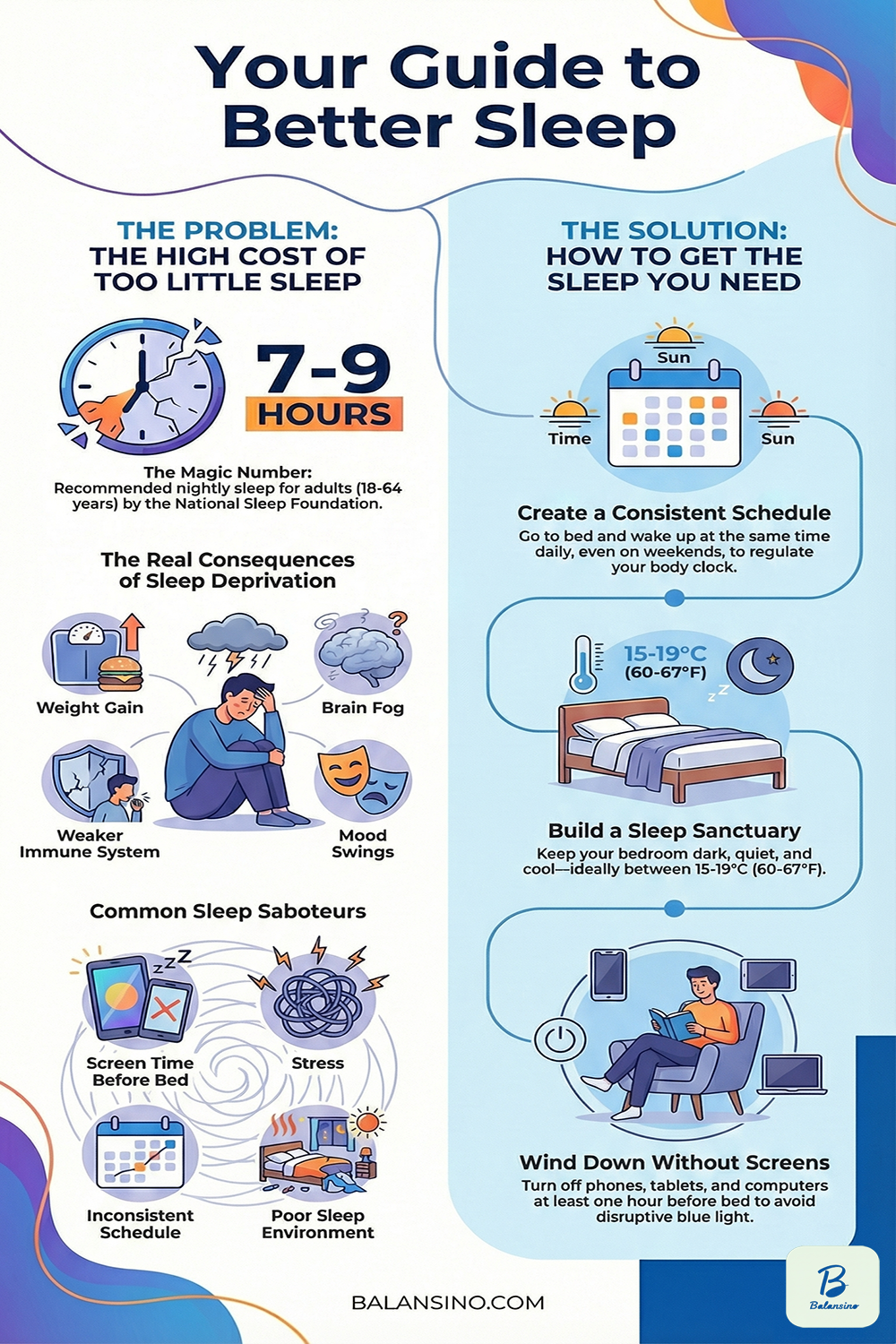
The National Sleep Foundation spent two years reviewing over 300 studies to figure this out. Here’s what they found:
- Adults (18-64 years old): 7-9 hours per night
- Older adults (65+): 7-8 hours per night
But here’s where it gets interesting. Some people genuinely need closer to 9 hours. Others function great on 7. It depends on your genetics, activity level, stress, and overall health.
Think of it like this: sleep is as individual as your fingerprint. The goal isn’t to hit some magic number. The goal is to find YOUR magic number.
How do you know if you’re getting enough? Ask yourself:
- Do you need an alarm to wake up, or do you naturally wake up feeling refreshed?
- Can you make it through the day without caffeine?
- Do you feel alert during boring activities (like sitting in a meeting)?
- Are you in a decent mood most of the time?
If you answered “no” to most of these, you’re probably not getting enough quality sleep.
📉 The Real Consequences of Not Sleeping Enough
Let me be straight with you. Chronic sleep deprivation isn’t just about feeling tired.
When you consistently sleep less than 7 hours, research shows you’re more likely to experience:
- Weight gain. Lack of sleep messes with the hormones that control hunger. Suddenly you’re craving donuts at 10 AM and can’t figure out why.
- Brain fog. Your memory, concentration, and decision-making all take a hit. Ever forget why you walked into a room? Yeah, that.
- Weakened immune system. You catch every cold that goes around because your body hasn’t had time to build up its defenses.
- Mood swings. Everything feels more irritating when you’re exhausted. Your patience disappears.
- Higher risk of serious health issues. We’re talking heart disease, diabetes, high blood pressure. Sleep isn’t optional for good health.
I’m not trying to scare you. I’m just being real. Your body NEEDS sleep to function properly. There’s no shortcut, no hack that replaces actual rest.
❓ Why You’re Not Sleeping Well (Even When You Try)
Maybe you’re thinking, “Okay, I GET IT. I need more sleep. But I literally can’t fall asleep.” Trust me, I’ve been there. You lie in bed, eyes wide open, mind racing about everything you need to do tomorrow. Or you fall asleep fine but wake up at 3 AM and can’t get back to sleep.
Here are the usual culprits:
- Your sleep environment is working against you. Too much light, wrong temperature, uncomfortable mattress, noisy neighbors. All of it matters.
- Your circadian rhythm is confused. You go to bed at different times every night. Your body has no idea when it’s supposed to sleep anymore.
- Stress and anxiety. Your brain won’t shut off because you’re worried about work, money, relationships, or that embarrassing thing you said in 2012.
- What you’re eating and drinking. Caffeine after 2 PM? That’s still in your system at bedtime. Heavy meal before bed? Your body is working overtime to digest instead of resting.
- Screen time before bed. That blue light from your phone is literally telling your brain it’s daytime. Not helpful when you’re trying to wind down.
The good news? Most of these are fixable with some simple changes.
If you’re struggling with falling asleep and staying asleep, there are natural solutions that support your body’s sleep-wake cycle. Many people have found success with targeted sleep support supplements that work with your natural rhythms. [Check out this science-backed option that’s helping thousands sleep better naturally →]
✅ The Solution: How to Actually Get the Sleep You Need
Okay, enough about the problem. Let’s talk solutions.
Getting quality sleep isn’t about forcing yourself to lie in bed for 8 hours. It’s about creating the right conditions for your body to naturally fall asleep and stay asleep.
Create a Sleep Schedule (And Actually Stick to It)
I know, I know. This sounds boring. But it works. Go to bed at the same time every night. Wake up at the same time every morning. Even on weekends. I’m serious. Your body loves consistency. Within a week or two, you’ll start naturally feeling sleepy at bedtime.
Make Your Bedroom a Sleep Sanctuary
Your bedroom should be dark, cool, and quiet. Invest in blackout curtains if you need to. Keep the temperature around 60-67°F (15-19°C). Use earplugs if your environment is noisy. And please, for the love of sleep, use your bed only for sleep (and sex). Don’t work in bed. Don’t watch TV in bed. Don’t scroll through your phone in bed. Train your brain that bed equals sleep.
Wind Down Properly
You can’t go from working on your laptop to sleeping in five minutes. Your body needs transition time. Create a bedtime routine. Maybe it’s reading for 20 minutes. Or taking a warm bath. Or doing some gentle stretches. Whatever helps you relax. Do it every night. Turn off screens at least an hour before bed. I know this is hard in our digital world. But the difference it makes is incredible. If you absolutely must be on your phone, at least use night mode to reduce blue light.
Watch What You Consume
Cut off caffeine by early afternoon. Even if you think it doesn’t affect you, it probably does. Avoid heavy meals within 3 hours of bedtime. A light snack is fine, but your body shouldn’t be working hard to digest while trying to sleep. Alcohol might make you drowsy initially, but it disrupts your sleep quality later in the night. Not worth it.
Move Your Body During the Day
Regular exercise helps you sleep better. Just not right before bed. Aim to finish any intense workouts at least 3-4 hours before sleep time. Even a 20-minute walk during the day can improve your sleep quality that night.
Want to optimize your sleep from the inside out? Supporting your body’s natural sleep processes with the right nutrients can make a huge difference. [Discover how this sleep support formula helps your body achieve deeper, more restorative rest →]
🧠 Understanding Sleep Cycles (The Nerdy But Important Stuff)
Here’s something cool: you don’t just “sleep” for 8 hours straight. You go through different stages in 90-minute cycles. Each cycle includes light sleep, deep sleep, and REM sleep. Deep sleep is when your body repairs itself physically. REM sleep is when your brain processes memories and emotions. You need to complete 4-5 full cycles per night to feel truly rested. That’s where the 7-9 hour recommendation comes from. It’s not random. It’s based on completing enough cycles. This is also why sometimes you feel great after 7.5 hours but terrible after 8 hours. You might have woken up in the middle of a cycle versus at the end of one. Try to time your sleep in 90-minute increments. If you need to wake up at 6 AM, aim to fall asleep at 10:30 PM (7.5 hours) or 9 PM (9 hours) rather than some random time.
💡 What About Naps?
Quick answer: Naps can be great if done right.
- Keep them short. 20-30 minutes max. Any longer and you’ll enter deep sleep, which makes you feel groggy when you wake up.
- Nap before 3 PM. Any later and it might interfere with your nighttime sleep.
But honestly? If you’re sleeping well at night, you shouldn’t need naps. If you’re constantly needing naps, that’s a sign you’re not getting enough quality sleep at night.
🛑 When to Be Concerned
Look, I’m not a doctor. But if you’re doing everything right and still struggling with sleep, it might be time to talk to a healthcare professional.
Warning signs include:
- Chronic insomnia lasting more than a month
- Loud snoring or gasping during sleep (could be sleep apnea)
- Extreme daytime fatigue despite sleeping enough hours
- Restless legs or uncomfortable sensations that prevent sleep
- Frequent nightmares or night terrors
Don’t mess around with serious sleep disorders. They’re real medical conditions that need proper treatment.
⚖️ The Bottom Line: Sleep Is Not Negotiable
Here’s what I want you to take away from this:
- Sleep isn’t lazy. It’s not wasted time. It’s essential maintenance for your body and mind.
- Most adults need 7-9 hours of quality sleep per night. Not 5. Not 6. Seven to nine.
- You can’t “catch up” on sleep during weekends. Your body doesn’t work that way.
- Good sleep hygiene makes a massive difference. Consistent schedule, dark room, cool temperature, no screens before bed, proper wind-down routine.
- And if you’ve tried everything and still struggle? Don’t give up.
Ready to finally experience the deep, refreshing sleep you deserve? Thousands of people have transformed their sleep quality by supporting their body’s natural sleep mechanisms. This isn’t about forcing yourself to sleep—it’s about helping your body remember how to do what it does naturally. [Click here to learn more about this breakthrough sleep support solution and start sleeping better tonight →]
Your Next Steps
Start tonight. Pick one thing from this article and implement it. Maybe it’s setting a consistent bedtime. Maybe it’s turning off your phone an hour before bed. Just start somewhere. Track how you feel after a week. I bet you’ll notice a difference. Your body wants to sleep well. Sometimes it just needs a little help getting back on track. Sleep well, friend. You deserve it.
🔬 Scientific Studies on the Topic
Disclaimer: The information shared here is not medical or diagnostic advice.
1. Sleep physiology, pathophysiology, and sleep hygiene
- Summary: This review highlights the fundamental biological functions of sleep and its role in maintaining cardiovascular, mental, and reproductive health, as well as cognitive function. It notes that sleep disorders and disrupted sleep from lifestyle choices contribute to significant morbidity. The authors emphasize that the best treatment for long-term sleep improvement is proper sleep hygiene, recommending 7 to 9 hours of sleep, a consistent schedule, and regular exercise. Furthermore, it advises avoiding caffeine, alcohol, heavy meals, and light exposure late in the day to prevent fragmented, poor-quality sleep.
- Source: https://pubmed.ncbi.nlm.nih.gov/36841492/
2. Good night and sleep well! – But what is really a healthy sleep?
- Summary: This article explores the definition of “healthy sleep,” moving beyond mere duration to include quality, timing, and the absence of sleep disturbances. It highlights that while 7–8 hours is often cited as ideal, individual needs vary. The review discusses how healthy sleep patterns—characterized by regular schedules and high efficiency—are linked to better cardiovascular and metabolic health. Conversely, the study notes that “long sleep” (>9 hours) is often only associated with increased mortality when combined with poor sleep quality or underlying health issues, rather than being harmful in itself for healthy individuals.
- Source: https://onlinelibrary.wiley.com/doi/10.1111/joim.13373
3. Evaluation of Sleep Habits and Disturbances Among US Adults, 2017-2020
- Summary: This cross-sectional study of over 9,000 US adults evaluates the differences in sleep habits between workdays and free days. The findings reveal significant variability: adults sleep longer and wake up later on free days, leading to “social jet lag” (averaging 1.1 hours) and “sleep debt.” Nearly 30% of adults reported trouble sleeping, and 27% experienced frequent daytime sleepiness. The study concludes that a high percentage of adults suffer from long-term sleep deprivation and chronic social jet lag, highlighting the need for strategies to optimize sleep health.
- Source: https://pubmed.ncbi.nlm.nih.gov/36346632/
These links emphasize that healthy sleep is defined not just by duration, but by consistency and quality. Science suggests that maintaining a regular sleep-wake schedule—even on weekends—is crucial to avoiding social jet lag and sleep debt, which are key factors in long-term cardiovascular and metabolic health.
Ready to finally experience the deep, refreshing sleep you deserve? Thousands of people have transformed their sleep quality by supporting their body’s natural sleep mechanisms. This isn’t about forcing yourself to sleep—it’s about helping your body remember how to do what it does naturally.
Written by @Balansino. Balansino Blog is based on decades of personal experience in health-related subjects—primarily autoimmune conditions, overweight/obesity, healthy nutrition and HEALTHY LIFESTYLE.