

🌅 Checklist of a Healthy Morning Routine: How to Turn Your Mornings from a Mess into an Invigorating Experience
*** The information shared here is not medical or diagnostic advice. This article contains affiliate links, meaning I earn a commission if you make a purchase through them. ***
Do you press the snooze button five times before finally draggint’g yourself out of bed? Does your day start with a sense of frenzied rushing, leaving you stressed before you even get your coffee? You are not alone. Millions of Peoples begin their day in survival mode, rushing through their morning without direction or energy. That afternoon brain fog, mid-morning energy slump, or that nagging sense of something being “off” for the entire day can often be traced back to those hectic initial hours after waking.
The thing is, your day is actually determined by your morning. If you wake up stumbling through your morning routine, you’re basically setting yourself up for a subpar day by programming your body and mind for that. But what if you could turn that around? What if your morning routine could be your edge for better concentration, energy, and productivity?
Now, let’s look at what a healthy morning routine checklist should actually look like—one that targets the real issues you’re having trouble with.

🤔 Why Your Current Morning Routine May Not Be Working for You
Now that we understand what’s wrong, let’s talk about what’s right. That is, what works. Rather than trying to fix the things that aren’t right with you, let’s work with what is right with you. This is called being in alignment with your body’s natural rhythms.
This means you need to understand what that is. That is, what time of day you’re most alert and awake. This is the opposite of what you’re probably thinking. You live in a culture that says the earlier
It’s not about your willpower. It’s that the classic morning routine advice does not respect the biological basis for energy and alertness. Your brain requires a certain type of support to get from a state of sleep to functioning at their best. If that’s not provided, the motivational advice of cold showers or motivational podcasts is pointless.
The Foundation: Understanding Your Body’s Wake-Up Process
Your body undergoes a complex process of activation everyday morning. Your pineal gland is a small but powerful gland that is crucial for governing your body’s sleep-wake cycle. When your body is functioning at its best, you tend to wake up with renewed energy. A stressed body, poor sleep, or the influence of a sedentary lifestyle can make waking up difficult for you.
That is the reason some people seem to wake up with their energy levels boosted, while for other people it takes one hour just to feel like a human being. It all depends on the effectiveness of the body in responding to this wake-up process.
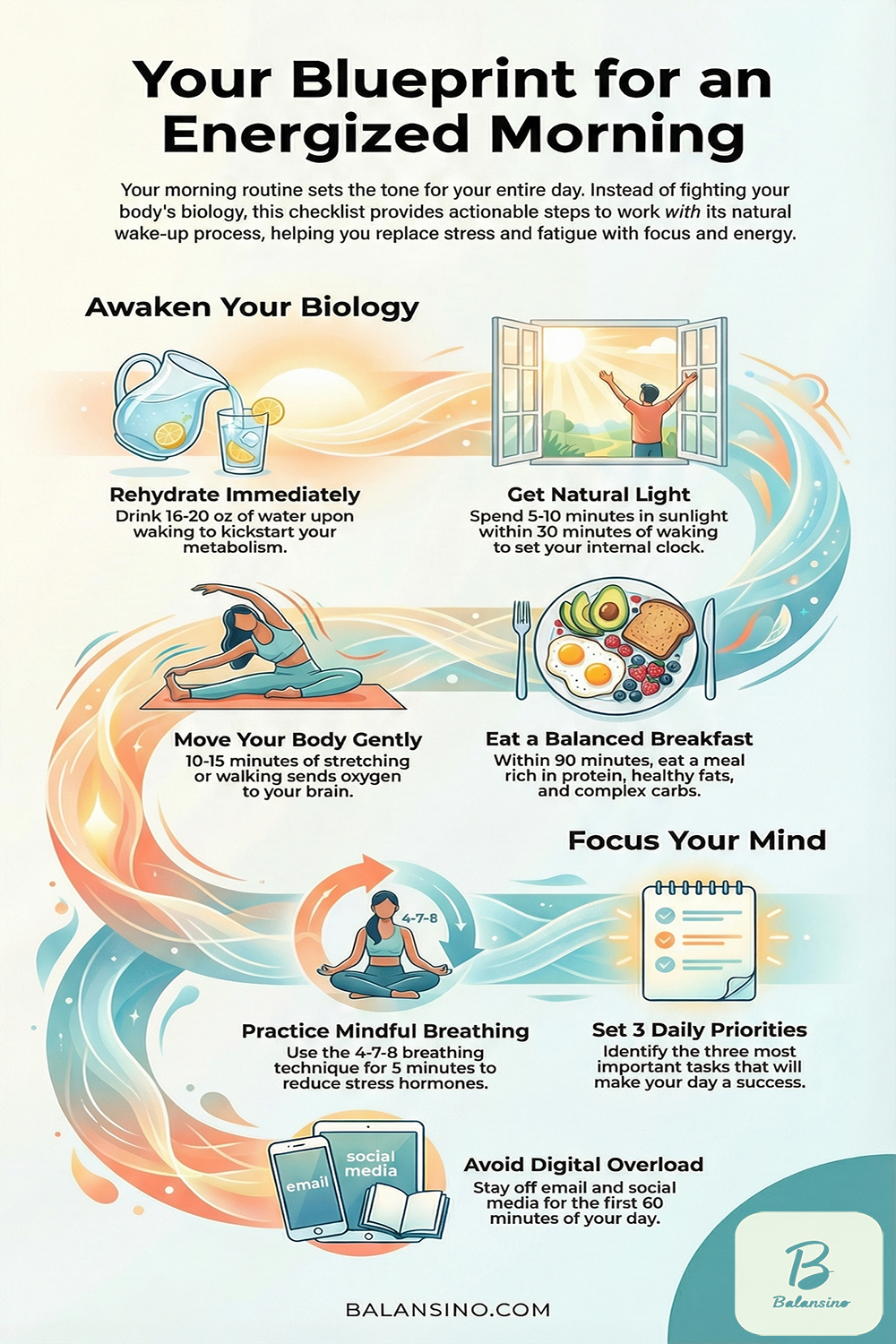
✅ Your Healthy Morning Routine Checklist
So let’s create a morning routine that works with your biology, not against it.
1. Rehydrate Immediately (for the First Five Minutes After Wakening)
Drink 16-20 ounces of water before coffee, before checking your phone. Your body has been without water for 6-8 hours. Drinking water starts your metabolism by flushing out the waste that built up in your body while you were sleeping. A pinch of sea salt and a squeeze of lemon juice add extra power for cell hydrating.
2. Expose Yourself to Natural Light (Within 30 Minutes)
Open your curtains or go outside for 5-10 minutes. Natural light tells your body that it is time to be awake and alert. This is one of the easiest ways to get your cortisol levels balanced while ensuring that you produce enough melatonin tonight for a great night’s sleep.
3. Move Your Body Gently (10-15 minutes)
You do not need to engage in a rigorous physical workout. Gentle stretching, yoga, or taking a walk around the block sends a message to your body that it is time for it to activate. This sends blood flowing, oxygenates your brain, and triggers the release of endorphin rush feelings without the need for a intense physical workout in the morning.
4. Facilitate the Natural Functions of the Brain
This is where the average morning routine goes wrong. Your brain requires some special nutritional support for it to work at its peak, particularly where the centers of clarity, concentration, and energy levels are concerned. Some people tend to wake up with that “foggy brain” feeling in the morning simply because they are not providing their brains with the ingredients they need to work at their best.
Now that you understand If you are frustrated with struggling through the day with brain fog and would like to help support your brains’ wakeful state, you can learn more about how nutritional support can make waking up easier. Click here to learn about something that works with what your body is biologically designed to do to improve your energy levels.
5. Practice Mindful Breathing (5-10 minutes)
Now, before you tackle your to-do list, take a couple of minutes to practice conscious breathing. You can try the 4-7-8 breathing technique: breathe in for a count of 4, hold your breath for 7, and breathe out for a count of 8. This stimulates your parasympathetic nervous system, which helps reduce levels of stress hormones in your body, promoting a state of clarity of mind
6. Balanced Breakfast (Within 90 Minutes)
Your first meal of the day matters too. You should prioritize eating protein, healthy fats, and complex carbohydrates. This would mean scrambled eggs with avocado and whole grain toast or Greek yogurt with nuts and berries. You should resist the sugar high that gets triggered by eating pastries or sugary breakfast cereals. Your brain does not need that glucose spike.
7. Set Your Daily Goals (5 minutes)
Now is the time to pick your three biggest things you need to accomplish. Not your to-do list, mind you, but the three things that would make it a successful day. This helps you stay on track and prevents you from wasting time on small stuff.
8. Avoid Digital Overload (First 60 minutes)
Avoid the temptation to check your emails or social media. These stimuli tend to divide your attention and activate your stress response before you even begin your day. Allow your brain to gather momentum in a positive way before you do.
🔑 The Missing Piece Nobody Mentions
You can do the work of this entire checklist and still feel like something is missing. That is because the nourishment for your brain to do the work of your morning routine is still pending. It is like trying to drive a car with old spark plugs. You can drive it, but it won’t run the way it should.
The pineal gland or other areas of the brain require certain nutrients for peak functioning. Modern diets, stress, environment, or natural aging can affect this very sensitive system. Things go south, and no matter what morning routine you do, it is like moving a boulder uphill.
So, are you ready to quit fighting your biology and start cooperating with it? Well, you can learn about this revolutionary way of helping your body support the energy-boosting systems of your brain by trying it out yourself. You can feel what it is like to wake up with a body that is ready for the day.
📅 Making It Stick: The 21-Day Morning Transformation
A change in your morning routine does not mean it’s got to be perfect; it’s about consistency. Begin with only three of the items from this checklist. It could be hydration, light, and movement. Get those down for a week before moving along.
- Record your feelings. Note the energy you feel at 10:00, 2:00, and 4:00. Your moods, alertness, and capacities for concentration at these times are more significant indicators than your feelings in the morning.
- Remember that some days are inevitably harder than others. This is a normal process. It is not the aim to wake up with a perfect start each day, but to provide a foundation that helps you more often than not.
“The Compound Effect of Better Mornings”
This is what most people do not get: their mornings provide their days, their weeks, and their lives with their value. When one begins the day with deliberate effort, one consumes better meals. One is more tolerant of one’s family. One is more innovative while working. One is in a position to achieve their objectives, rather than merely surviving.
“Small changes to your daily morning routine have big effects.” So, after a month of upgraded mornings, you’ll look back and hardly recognize who you used to be. That energy slump you got at 2 PM? History. Brain fog in the morning? History too. Feeling overwhelmed before 9 AM? History.
Your Next Step
You now possess a scientifically valid healthy morning routine checklist. You understand what went wrong with your previous healthy morning routine approaches and what your brain actually requires to work at its best. It is not a question of you being able to achieve better mornings. It is a question of whether you choose to do so.
“Start tomorrow. One thing. Drink that water. Get that sunlight. Move that body. And if you are ready to provide your brain with what it’s been deprived of, then there’s never been a better time to make that investment in your morning metamorphosis.”
Don’t let another day go by with mornings that blur together in a haze of tiredness and irritation. Discover the natural key that thousands of people just like you are using to turn their mornings around and unlock the true power of their brains. Your best days begin with better mornings, and better mornings begin with the right help. Click here to begin realizing the energized and focused mornings you’ve been wanting.
Your future self will thank you for the decision you make today. “Because life is too short to waste your mornings—and too precious to spend your days running on empty.”
Your Future Self Will Thank You for This Decision.
🔬 Scientific Studies on the Topic
Disclaimer: The information shared here is not medical or diagnostic advice.
1. Light affects morning salivary cortisol in humans
- Summary: This study investigated the effect of light exposure on the morning cortisol peak in fourteen healthy men. Exposure to 800 lux of light for one hour in the early morning resulted in a significant 35% increase in salivary cortisol levels compared to darkness. This effect was time-dependent, as light had no effect on cortisol levels when applied in the late evening. The results demonstrate that early morning light conditions strongly impact the morning cortisol peak, potentially mediated by the circadian pacemaker.
- Source: https://pubmed.ncbi.nlm.nih.gov/10487717/
2. The Cortisol Awakening Response: Regulation and Functional Significance
- Summary: This review focuses on the Cortisol Awakening Response (CAR), the rapid increase in cortisol 30 to 45 minutes after waking, which prepares the body for the challenges of the day. It proposes an integrative model of the CAR, regulated by a dual-control system involving circadian, environmental, and neurocognitive factors. The CAR’s functions are to mobilize metabolic, immunological, and neurocognitive resources to meet daily demands and to help the organism counterregulate adverse emotional experiences from the previous day.
- Source: https://pubmed.ncbi.nlm.nih.gov/39177247/
3. Effects of using a snooze alarm on sleep inertia after morning awakening
- Summary: This study investigated the effect of using a snooze alarm on sleep inertia, the transitional state of reduced arousal and impaired performance immediately after waking. Researchers found that while 70.5% of surveyed students frequently use the snooze function (mainly to reduce anxiety about oversleeping), lab results suggest the snooze alarm prolongs sleep inertia compared to a single alarm. This is likely because the snooze function induces repeated forced awakenings, which prolonged waking and the drowsy Stage N1 sleep during the last 20 minutes before final awakening.
- Source: https://pubmed.ncbi.nlm.nih.gov/36587230/
4. Self-awakening improves alertness in the morning and during the day after partial sleep deprivation
- Summary: This crossover trial investigated the effects of self-awakening (waking up without an alarm) versus forced awakening on alertness following partial sleep deprivation (5 hours of sleep). The results showed that self-awakening significantly improved alertness (faster response speed on psychomotor tasks) both immediately upon waking (by eliminating sleep inertia) and throughout the day. The study concludes that self-awakening is a beneficial strategy to reduce sleep inertia and alleviate daytime sleepiness heightened by restricted sleep.
- Source: https://pubmed.ncbi.nlm.nih.gov/25130898/
These links explore the physiological and behavioral factors influencing the start of the day. The scientific findings emphasize the importance of the Cortisol Awakening Response (CAR) for daily preparation, noting that early morning light exposure positively influences this response, while practices like using the snooze function can prolong the negative effects of sleep inertia.
Don’t let another day go by with mornings that blur together in a haze of tiredness and irritation. Discover the natural key that thousands of people just like you are using to turn their mornings around and unlock the true power of their brains. Your best days begin with better mornings, and better mornings begin with the right help. Click here to begin realizing the energized and focused mornings you’ve been wanting.
Written by @Balansino. Balansino Blog is based on decades of personal experience in health-related subjects—primarily autoimmune conditions, overweight/obesity, healthy nutrition and HEALTHY LIFESTYLE.