⚖️ PILLAR 4 OF 5
Work-Life Balance
and Stability
Your work should support your life — not consume it. When work is balanced and stable, you thrive. When it’s out of control or uncertain, everything else suffers.
THE REALITY
😔 Does This Sound Familiar?
It’s 9 PM. You’re still at your desk — or worse, you left the office hours ago but you’re still mentally there.
Your phone is next to you. You keep checking it. Not because anything urgent is happening, but because you’ve lost the ability to stop. The line between work time and your time dissolved so gradually you didn’t notice it happening. Now you’re not sure where one ends and the other begins.
You’re tired. Not the kind of tired that sleep fixes — the other kind. The kind that sits behind your eyes and follows you into the weekend. You keep telling yourself that once this project is done, once things calm down, once you get through this quarter… you’ll finally exhale.
But things don’t calm down. They just change shape.
Sound familiar?
Maybe it’s not overwork. Maybe it’s the opposite — the dread of financial instability, the quiet panic of a job that feels wrong but feels safer than the unknown, the grind of doing work that means nothing to you just to keep the lights on.
Either way, your work-life balance and stability is off. And you can feel it in everything — your body, your relationships, your ability to enjoy anything that isn’t work.
You’re not lazy. You’re not failing. You’re just running a system that wasn’t designed to be sustainable.
THE IMPACT
⚠️ What Happens When Work-Life Balance Falls Apart?
When work takes over — or when financial instability creates constant background stress — life becomes an exhausting grind. You’re always “on,” yet never feel like you’re getting ahead. Days blur together in a cycle of work, worry, and a fatigue that never quite lifts.
The signs of imbalance show up in ways that are hard to miss once you know what to look for:
- Working long hours with nothing left over for yourself, your family, or the life you’re supposedly working for
- Burnout that makes everything feel pointless — even the things that used to matter
- Chronic stress from financial pressure that hums in the background of every decision
- Thinking about work even when you’re not there — on holidays, at dinner, lying awake at 2 AM
- Low productivity despite long hours, because exhaustion isn’t the same as effort
- Feeling trapped — in a job you hate, in a situation that feels impossible to change
- Neglecting your health, your relationships, your leisure — because there’s “no time,” and there never will be unless something changes
Here’s the brutal truth: work should be one part of a full life. Not the whole thing. When it becomes the whole thing — by pressure, by habit, or by financial necessity — everything else pays the price. And eventually, so does the work.
THE TWO-WAY STREET
🔄 It Goes Both Ways
Work stress doesn’t stay at work. But the reverse is equally true — and it matters.
When other areas of your life are out of balance, your work suffers.
Poor sleep from chronic stress tanks your focus and decision-making. Relationship conflict at home makes it impossible to show up fully at work. When your body is depleted, your productivity collapses no matter how many hours you put in. Anxiety and depression — which thrive in conditions of overwork and isolation — directly impair the cognitive functions that work demands most.
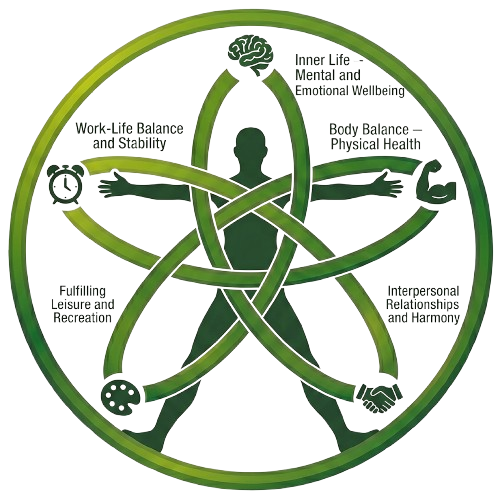
You can’t compartmentalize your way out of this. The pillars are connected. Which is exactly why fixing only the work side of the equation is never quite enough — and why at Balansino we look at all five areas together.
“Work stress doesn’t stay at work. And when your work life is stable and sustainable, it strengthens everything else.”
THE BALANSINO FIVE-PILLAR APPROACH
THE OTHER SIDE
✨ What Does Work-Life Balance and Stability Actually Feel Like?
Not perfect. Not a job you love every single day, or a bank account with no worries, or a calendar with nothing urgent on it.
Just sustainable.
You do work that feels meaningful often enough to keep you going. You earn enough to meet your needs without a constant undercurrent of financial dread. When the workday ends, you can actually leave it — mentally, not just physically. You have energy left over. For the people you love. For your body. For rest that actually restores you.
When your work-life balance and stability are in balance:
🚧
Boundaries exist
And you’re actually able to keep them — not just set them and watch them erode.
💰
Financial security
Reduces the background noise of anxiety so you can actually be present in your life.
🎯
Your work feels purposeful
Not just a transaction you endure — something worth the hours you give it.
⚡
Productivity is sustainable
Output without the burnout — consistent effort without running yourself into the ground.
🗺️
You have some sense of direction
Even if the path isn’t perfectly clear, you’re not just reacting anymore.
🕐
Time off is real
Not guilt-ridden, not interrupted — actually restorative in the way rest is supposed to be.
🌱
Energy remains
For relationships, health, and the rest of your life — not just the bare minimum.
That’s the goal. Not hustle culture. Not “quiet quitting” either. Just a professional life that fits inside a full human life — not the other way around.
WHAT’S COVERED
🎯 The Key Areas of Work-Life Balance and Stability
Work-life balance isn’t one thing. It’s built across several interconnected areas — and what’s most out of alignment looks different for everyone.
🔲
Work-Life Balance
The foundation: creating rhythms and boundaries that let work coexist with the rest of your life rather than dominate it. This is harder than it sounds — especially when the culture around you treats overwork as virtue, when you work from home and the office is always open, or when financial pressure makes saying no feel dangerous.
But the alternative — giving everything to work indefinitely — doesn’t end well. For anyone.
Setting work boundaries · managing work hours · unplugging from work · protecting personal time · work-life integration
🗺️
Career Planning and Direction
Uncertainty is exhausting. Not knowing where you’re headed — or feeling like you’re on the wrong path entirely — creates a specific kind of low-grade dread that’s hard to shake.
Having some sense of direction, even a rough one, creates stability. It turns reactive decisions into intentional ones. And intentional tends to work out better.
Career goals · professional development · skill building · finding your path · long-term planning
🔄
Job Change and Career Transitions
Changing jobs or careers is rarely as clean as it looks from the outside. It’s messy, uncertain, and genuinely scary — even when you know the current situation isn’t working.
But staying somewhere that’s wrong for you has costs too. Real ones. Navigating transitions intentionally — rather than fleeing in desperation or staying out of fear — is a skill worth building.
Job search strategies · career pivots · leaving a job well · interview preparation · managing career change stress
⏱️
Productivity and Time Management
Real productivity isn’t about doing more. It’s about doing what actually matters — efficiently, sustainably, without running yourself into the ground in the process.
Most productivity problems aren’t discipline problems. They’re clarity problems, boundary problems, or simply the result of trying to do too much with not enough recovery built in.
Focus and concentration · prioritization · productivity systems · deep work · managing distractions · time-blocking
😤
Workplace Stress Management
Some work stress is normal. Chronic workplace stress is something else entirely — and it’s worth treating seriously, not just managing better.
The research on prolonged occupational stress is clear: it raises cortisol, disrupts sleep, weakens immune function, and increases cardiovascular risk. Your job is affecting your body whether you acknowledge it or not.
Coping with work pressure · managing difficult colleagues · stress relief at work · work anxiety · resilience
🔥
Burnout Prevention and Recovery
Burnout isn’t just being tired. It’s emotional depletion, cynicism, and a loss of the ability to care — even about things you used to care about deeply.
It doesn’t arrive all at once. It builds slowly, disguised as dedication, until one day you realize the person who cared so much about this work is just… gone. Recognizing the signs early — and taking them seriously — is far easier than recovering from the full version.
Recognizing burnout · recovering from burnout · preventing burnout · sustainable work habits · rest and recovery
💰
Financial Stability
Financial stress is one of the most pervasive and underacknowledged sources of chronic anxiety in modern life. It’s not just about money — it’s about the feeling of having options. Of not being one unexpected expense away from crisis.
Building financial stability doesn’t require a high income. It requires intention, some basic structures, and the willingness to look honestly at where things stand.
Budgeting basics · saving and investing · debt management · building an emergency fund · salary negotiation · financial planning
🏠
Remote Work and Flexibility
Remote work offers real freedom. It also offers the freedom to never stop working — and many people have discovered that one the hard way.
Working from home effectively means building the boundaries that the office used to provide automatically. It means designing your environment, your schedule, and your habits intentionally — because without that intention, work expands to fill every available hour.
Home office setup · remote work productivity · work-from-home boundaries · hybrid work · managing isolation · virtual communication
🤝
Workplace Relationships
You spend more waking hours with your colleagues than almost anyone else in your life. The quality of those relationships matters — more than most job descriptions acknowledge.
A supportive work environment makes difficult work bearable. A toxic one makes good work miserable. Navigating professional relationships well — with colleagues, managers, and the people you lead — is part of work-life stability, not separate from it.
Professional communication · dealing with difficult colleagues · networking · building work friendships · managing conflict at work
THE BIGGER PICTURE
🔗 How Work-Life Balance Connects to the Other Pillars
At Balansino, your work life doesn’t exist in isolation — because in reality, it never does.
When work is out of balance, everything else is affected. Chronic work stress weakens your immune system and disrupts sleep. Burnout drains the emotional reserves you need for your relationships. Long hours leave no room for movement, rest, or joy. Financial instability creates a baseline anxiety that colors every other part of life.
But when your work life is stable and sustainable, it strengthens everything else. Financial security reduces the background noise. Meaningful work gives you a sense of purpose that spills into how you show up everywhere else.
💪
Body Balance — Physical Health
Chronic occupational stress raises cortisol, disrupts sleep, and accelerates physical decline. Your body registers work stress whether you acknowledge it or not.
🧠
Inner Life — Mental and Emotional Wellbeing
Burnout, job insecurity, and financial pressure are among the most common drivers of anxiety and depression. The connection runs deep — and in both directions.
🤝
Interpersonal Relationships and Harmony
When you’re overextended at work, you bring the worst version of yourself home. The people closest to you feel it first — and longest.
🎨
Fulfilling Leisure and Recreation
Leisure squeezed between work obligations isn’t really leisure. Real rest requires real boundaries — and those have to be built intentionally, not hoped for.
ONE SMALL STEP
🚀 Your Work Life Is Worth Getting Right
You didn’t build a career so that work could take over your life. Somewhere along the way that might have happened anyway — gradually, almost invisibly. But it’s not irreversible.
Change doesn’t require quitting everything and starting over. It starts with one boundary actually held. One honest conversation about what’s sustainable. One financial decision made with intention instead of avoidance.
Your work should support your life. If it doesn’t, that’s worth fixing. And it can be fixed.