
🤝 PILLAR 3 OF 5
Interpersonal Relationships
and Harmony
Humans are wired for connection. When your relationships are harmonious, life feels richer. When they’re strained or absent, even success in every other area feels hollow.
THE REALITY
😔 Does This Sound Familiar?
You’re surrounded by people. A partner, maybe. Family. Colleagues. Friends — or at least people you used to call friends.
And yet somehow, you feel alone.
Not dramatically alone. Not in-a-crisis alone. Just… quietly, persistently disconnected. Like there’s a glass wall between you and everyone else, and you can see them but you can’t quite reach them.
Or maybe it’s the opposite. Your relationships are full of noise — conflict that keeps circling back, tension that never fully resolves, someone who drains you every time you interact but you can’t figure out how to change it. You’re not alone at all. You just wish you were.
Either way, something is off — and you feel it everywhere.
Not just in your relationships. In your sleep. In your mood. In the way the workday feels heavier than it should. In the way even good moments have a flatness to them that’s hard to explain.
You’re not broken. Connection is just hard — and nobody teaches us how to do it well. That’s exactly what this pillar is about.
THE IMPACT
⚠️ What Happens When Relationships Fall Out of Balance?
When your relationships are strained, absent, or one-sided, the effects run deep.
Loneliness becomes a constant background hum. Conflict you can’t resolve wears you down slowly — the kind of tired that sleep doesn’t fix. Resentment builds quietly until you don’t even recognize the relationship anymore.
The signs show up in ways you might not immediately connect to your relationships:
- Feeling isolated even when surrounded by people
- Constant low-grade conflict with someone you care about
- Struggling to say what you actually need — or even know what that is
- Difficulty trusting people, or letting anyone get close
- Giving and giving until there’s nothing left — and still feeling guilty
- Staying in relationships that drain you because familiar feels safer than unknown
- Feeling unseen. Misunderstood. Like no one really knows you.
Here’s the part that matters: when your relationships suffer, everything else does too.
Emotional turmoil from conflict disrupts your sleep and shows up in your body. Loneliness — and this is backed by research — affects your physical health as significantly as smoking. The stress of a relationship that feels unsafe or unstable spills into your work, your focus, your ability to enjoy anything. Humans aren’t built to navigate life alone.
THE TWO-WAY STREET
🔄 It Goes Both Ways
Relationship problems don’t stay contained in your relationships. But the reverse is also true — and it’s worth saying clearly.
When other areas of your life are out of balance, your relationships pay the price.
Chronic work stress makes you short-tempered with the people you love most. Physical exhaustion leaves you with nothing to give. Anxiety turns every interaction into something to manage rather than enjoy. When you’re running on empty, genuine connection becomes almost impossible — not because you don’t care, but because there’s nothing left.
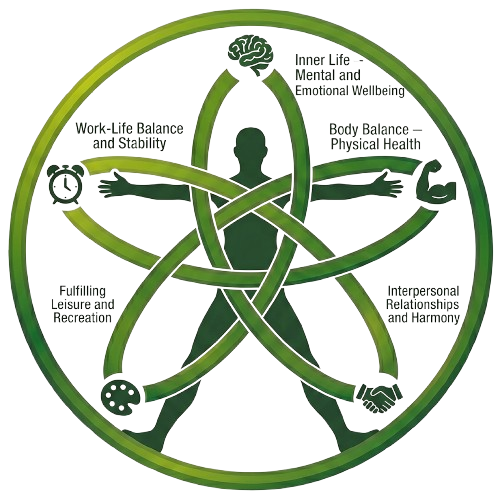
This is why at Balansino we look at all five pillars together. You can’t fix your relationships in isolation — any more than you can fix your sleep while your mind is constantly racing. It all connects.
“When other areas of your life are out of balance, your relationships pay the price — and when your relationships struggle, everything else does too.”
THE BALANSINO FIVE-PILLAR APPROACH
THE OTHER SIDE
✨ What Does Relationship Harmony Actually Feel Like?
It doesn’t mean no conflict. It doesn’t mean everyone likes each other all the time. It doesn’t mean perfect.
It means safe.
You can say what you actually think — and trust that the relationship will hold. Disagreements happen, and they get resolved instead of buried. You feel genuinely seen by the people closest to you, not just tolerated. You give and receive support without keeping score.
When your interpersonal relationships and harmony are in balance:
🗣️
Communication is honest and kind
You can say the hard things without fear of the relationship falling apart.
🤲
Conflict gets resolved
Not avoided, not weaponized — actually worked through and moved past.
🔒
Boundaries exist and are respected
Yours and theirs — without guilt, without resentment.
💛
You feel genuinely connected
Seen, valued, and not alone — even when life gets hard.
⚖️
Relationships feel reciprocal
Not one person carrying all of it. The weight is shared.
🏡
You have a real support system
People you can actually lean on when things get hard — not just in theory.
That’s relationship harmony. Not perfection. Just connection that nourishes you more than it drains you — most of the time.
WHAT’S COVERED
🎯 The Key Areas of Interpersonal Relationships and Harmony
Relationship balance isn’t one thing. It’s built across several interconnected areas — and what needs attention looks different for everyone.
💑
Romantic Relationships
Romantic partnerships require more intention than most of us realize — especially over time. The early ease of a new relationship doesn’t last forever. That’s not failure. That’s just how it works.
Sustaining real connection requires showing up even when it’s inconvenient, navigating the inevitable rough patches without shutting down or blowing up, and continuing to choose each other — consciously, not just by default.
Building healthy partnerships · dating with intention · intimacy · trust and vulnerability · maintaining connection · navigating relationship challenges
💍
Marriage and Long-Term Partnership
Long-term relationships change. The people in them change. And the ones that last aren’t the ones without problems — they’re the ones where both people keep choosing to work on it.
Sustaining harmony in a long-term partnership means adapting to who you both are becoming, not just who you were when you started. It means fighting for the relationship, not just in it.
Strengthening marriage · couples communication · managing conflict · shared goals · keeping connection alive · working through rough patches
👨👩👧
Family Relationships
Family dynamics are some of the most complex relationships we ever navigate — because they carry history, expectation, and patterns that were set long before we had any say in the matter.
Building harmony with family doesn’t mean pretending old wounds don’t exist. It means finding ways to connect despite them — and sometimes, setting boundaries that protect your peace without severing the relationship entirely.
Parent-child relationships · sibling dynamics · extended family · family conflict · setting boundaries · healing old patterns
👯
Friendships
Friendships are the relationships we actually choose. And yet they’re often the first thing to fall away when life gets busy — quietly, without a formal ending, until one day you realize you haven’t had a real conversation with someone who knows you in months.
Strong friendships don’t just happen. They require time, effort, and the willingness to be a little vulnerable. They’re worth it.
Making friends as an adult · deepening friendships · maintaining long-distance friendships · navigating friendship changes · letting go of toxic friendships
👶
Parenting
Parenting is one of the most profound relationships you’ll ever have — and one of the hardest to get right, because the stakes feel impossibly high and the feedback loop is slow.
It requires patience you sometimes don’t have, flexibility when you’d rather have control, and the humility to keep learning as your children grow into people you didn’t expect. There’s no perfect parent. There’s just the one who keeps showing up.
Positive parenting · parent-child communication · setting boundaries with children · managing parenting stress · raising emotionally healthy kids
🗣️
Communication Skills
Most relationship problems, at their core, are communication problems. Not because people don’t care — but because saying what you actually mean, clearly and without it landing as an attack, is genuinely hard.
Active listening is hard. Staying present when you’re defensive is hard. Most of us were never taught how to do any of this. The good news: it’s learnable.
Active listening · assertive communication · nonviolent communication · expressing needs · difficult conversations · empathy in communication
⚔️
Conflict Resolution
Conflict isn’t the problem. Conflict is inevitable — in every relationship, with every person you’re close enough to for it to matter.
The difference between harmony and ongoing discord is what happens after the conflict starts. Whether you fight to win or fight to understand. Whether repairs happen or resentments accumulate. Navigating disagreement well is one of the most valuable skills you can build.
Healthy conflict · repair after arguments · avoiding defensiveness · finding compromise · apology and forgiveness · de-escalationstillness
🚧
Boundaries
Boundaries aren’t walls. They’re not punishment, or rejection, or proof that you don’t care. They’re the thing that makes it possible to stay in relationships long-term without losing yourself in them.
When boundaries are unclear or consistently violated — in either direction — resentment follows. Every time. Setting and honoring boundaries is how relationships stay safe for everyone in them.
Setting personal boundaries · respecting others’ limits · saying no without guilt · boundary violations · balancing giving and receiving
🫂
Loneliness and Building Connection
Loneliness isn’t always about being alone. You can be the loneliest person in a room full of people — even people who care about you. It’s about lacking the kind of connection where you feel genuinely known.
Building that — especially as an adult, when the structures that used to create friendships automatically no longer exist — takes real effort. It also takes courage. But it’s one of the most worthwhile investments you can make in your own life.
Overcoming loneliness · making new friends as an adult · building community · social anxiety · finding your people · cultivating belonging
THE BIGGER PICTURE
🔗 How Mental and Emotional Wellbeing Connects to the Other Pillars
At Balansino, relationships don’t exist in a vacuum — because in real life, they never do.
When your relationships are struggling, the ripple effects spread fast. Chronic conflict disrupts your sleep and shows up in your body as physical tension and fatigue. Loneliness increases the risk of anxiety and depression. The emotional drain of an unhealthy relationship leaves you with less capacity for your work, your health, and your joy.
But when your relationships are solid, they strengthen everything else. A genuine support system makes hard times survivable. Feeling truly seen by someone gives you a kind of steadiness that no amount of solo self-improvement can replicate.
💪
Body Balance — Physical Health
Research links chronic loneliness to weakened immune function and increased disease risk. The body keeps the score of relationship stress — in ways that are measurable, not just felt.
🧠
Inner Life — Mental and Emotional Wellbeing
Our mental health is deeply shaped by the quality of our connections. Isolation amplifies anxiety and depression. Safe, supportive relationships do the opposite.
⚖️
Work-Life Balance and Stability
Conflict at home spills into work. Feeling unsupported at work spills into home. The two bleed into each other more than most people want to admit.
🎨
Fulfilling Leisure and Recreation
Joy is better shared. Even solitary hobbies feel richer when there’s someone to come home to — someone who’s genuinely glad you’re there.
ONE SMALL STEP
🚀 Your Relationships Are Worth the Work
Most relationship problems don’t resolve on their own. They either get worked through — or they quietly get worse.
But it doesn’t have to mean dramatic overhauls. It can start with one honest conversation. One boundary finally stated clearly. One friendship given a little more time and attention than usual.Small, consistent efforts create profound shifts over time. Your relationships deserve that kind of care. And so do you.