
🧠 PILLAR 2 OF 5
Inner Life —
Mental and Emotional Wellbeing
Your inner world shapes everything. When your mind and emotions are in balance, life feels manageable — even good. When they’re not, even simple things can feel overwhelming.
THE REALITY
😔 You Know That Voice, Don’t You?
It’s not loud. It doesn’t announce itself.
It shows up at 2 AM when you can’t sleep. It’s there in the shower when your mind won’t stop spinning. It whispers that you’re falling behind, that you’re not doing enough, that something is wrong with you — even when, by every objective measure, your life is fine.
You go through the motions. You show up. You get things done. But underneath the surface, there’s this constant low-grade hum. A tension you can’t quite name. A tiredness that sleep doesn’t fix.
Maybe you snap at the people you love over nothing — and then feel guilty about it for days. Maybe you’ve stopped doing the things that used to make you happy, and you’re not even sure when that happened. Maybe you feel like you’re watching your own life from a slight distance, going through the motions but not really in it.
You’re not dramatic. You’re not weak. You’re not broken.
Your mental and emotional wellbeing is out of balance — and that changes everything.
THE IMPACT
⚠️ What Happens When Your Inner Life Falls Out of Balance?
When your inner world is struggling, everything else gets harder.
Stress that would normally be manageable feels crushing. Small annoyances trigger reactions that surprise even you. You feel disconnected from yourself — from what you want, who you are, what the point of any of it is.
The signs of imbalance are different for everyone, but they tend to show up like this:
- Constant worry and racing thoughts that won’t quiet down
- A low mood that’s become your baseline — not dramatic sadness, just… gray
- Feeling numb, empty, or emotionally exhausted
- Struggling to concentrate or make even simple decisions
- Losing interest in things that used to bring you joy
- Harsh self-criticism that you’d never direct at someone you love
- A nagging sense that life should feel more meaningful than this
Left unaddressed, these struggles don’t stay contained. They spill into your relationships, your work, your body, your ability to enjoy any of it. Your mental and emotional wellbeing isn’t separate from the rest of your life — it’s the lens through which you experience everything. When that lens is cracked, nothing outside you can fully fix how things feel on the inside.
THE CONNECTION
🔄 It Goes Both Ways
Here’s something important — and it works in both directions.
When your inner life is struggling, the other areas of your life suffer. But the reverse is equally true: when other areas of life are out of balance, your inner world pays the price.
Chronic work stress doesn’t just feel bad mentally. Research consistently links prolonged stress to disrupted sleep, weakened immune function, hormonal dysregulation, and increased risk of anxiety and depression. Relationship conflict that never gets resolved creates a constant background drain on emotional resources. Physical exhaustion makes emotional resilience nearly impossible.
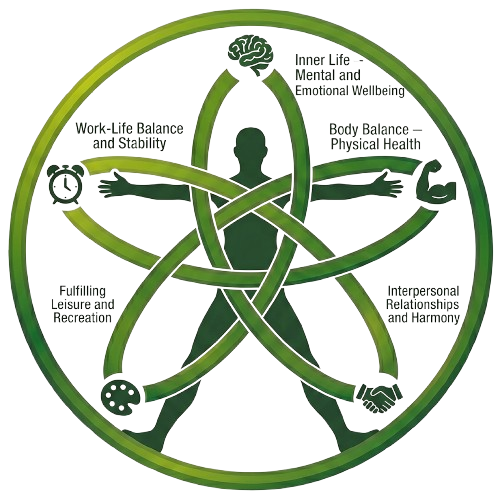
Your inner life absorbs the impact of everything that’s out of balance — which is exactly why at Balansino, we look at all five pillars together, not in isolation.
“Your inner life is the lens through which you experience everything. When that lens is cracked, nothing outside you can fully fix how things feel on the inside.”
— THE BALANSINO PHILOSOPHY
THE VISION
✨ What Does Balanced Mental and Emotional Wellbeing Actually Feel Like?
Let’s paint a different picture.
You wake up and your mind is quiet. Not empty — just calm. You can think clearly. The day ahead has challenges, but they don’t feel insurmountable. You feel grounded in who you are and what matters to you.
Stress still happens. Hard emotions still come — grief, frustration, fear. But they move through you instead of getting stuck. You can handle what comes at you. You bounce back. You find perspective.
That’s not a fantasy. That’s what mental and emotional wellbeing in balance actually looks like:
🧘
Emotional resilience
Setbacks happen, but they don’t flatten you. You recover.
🧠
Mental clarity
You can think straight, focus, and make decisions without it feeling exhausting.
💛
Self-compassion
You treat yourself with the same basic kindness you’d give a friend.
🎯
A sense of purpose
A feeling that what you do and who you are actually matters.
😌
Inner steadiness
Not constant happiness — a groundedness that doesn’t depend on everything going right.
😤
Healthy emotional expression
You can feel your feelings without suppressing them or being overwhelmed by them.
When your inner life is in balance, you’re not perfect. But you’re present. You show up for your life instead of watching it from a distance.
THE FRAMEWORK
🎯 The Key Areas of Mental and Emotional Wellbeing
Mental and emotional wellbeing isn’t one thing. It’s built across several interconnected areas — and when one is struggling, you feel it everywhere.
😰
Stress Management
Stress is inevitable. Chronic, unmanaged stress is not — but it’s become the default for most people. When stress is constant and unrelenting, it doesn’t just feel bad. It disrupts sleep, affects digestion, weakens immunity, and slowly erodes the emotional reserves you need for everything else.
Learning to recognize stress, interrupt it, and respond differently isn’t a luxury — it’s one of the most important things you can do for your health.
Stress reduction techniques · coping strategies · relaxation practices · breathing exercises · the stress-health connection
😟
Anxiety and Worry
Anxiety isn’t always panic attacks and crisis moments. For most people, it’s quieter than that. It’s the constant low-level worry that follows you everywhere. The overthinking that makes decisions feel impossible. The “what ifs” that hijack your mind at 3 AM. The way certain situations trigger a level of dread that seems disproportionate.
Understanding what’s actually happening when you’re anxious — and developing real tools to work with it — makes a significant difference.
Generalized anxiety · social anxiety · panic · worry management · grounding techniques · cognitive strategies
😔
Depression and Low Mood
Depression isn’t always what it looks like in the movies. Sometimes it’s a heaviness that settles in slowly — a loss of color in things that used to be vivid. A growing disinterest in life. A flatness you can’t explain to people who haven’t felt it. You’re functional. You’re showing up. But something is missing, and you’re not sure when it went.
Recognizing the signs — and understanding that this isn’t a character flaw or a failure — is the first step toward finding your way back.
Understanding depression · mood regulation · finding support · self-care for low mood · hope and recovery
💡
Emotional Intelligence
Your ability to recognize, understand, and work with your emotions — and to read and respond to the emotions of others — shapes nearly every important relationship and decision in your life.
Emotional intelligence isn’t a fixed trait. It’s a set of skills you can develop. And when you do, everything from your closest relationships to your ability to navigate workplace conflict gets meaningfully easier.
Self-awareness · emotional regulation · empathy · reading emotions · emotional expression
💪
Self-Esteem and Confidence
How you see yourself shapes everything — what you pursue, what you settle for, what you believe you deserve. Genuine self-esteem isn’t about positive affirmations or performing confidence. It’s about developing a stable, honest relationship with yourself — one rooted in self-acceptance rather than the impossible standard of perfection.
When you stop treating yourself as the one person in your life who doesn’t deserve basic kindness, everything shifts.
Building confidence · overcoming self-doubt · self-compassion · the inner critic · worthiness
🌟
Positive Mindset and Gratitude
This isn’t about toxic positivity or pretending everything is fine when it’s not. It’s about recognizing that the way you habitually interpret events — your explanatory style — has a real and measurable impact on your wellbeing. And that this isn’t fixed. The way you think can be shaped, over time, with practice.
Gratitude, optimism, and reframing aren’t naive. They’re evidence-based tools that consistently show up in research on psychological resilience.
Gratitude practices · optimism · reframing thoughts · positive psychology · resilience mindset
🧘
Mindfulness and Meditation
Your mind spends a surprising amount of time somewhere other than the present moment — replaying the past, rehearsing the future, narrating, judging, worrying. Mindfulness isn’t about emptying your mind or achieving some special state of calm. It’s about learning to notice where your attention is, and gently returning it to the present.
That skill — small as it sounds — has a profound effect on stress, anxiety, emotional regulation, and overall wellbeing.
Meditation for beginners · mindfulness practices · present-moment awareness · breathwork · inner stillness
🎯
Purpose and Meaning
A life without a sense of meaning is survivable — but it’s hard to call it living. Purpose doesn’t have to be grand. It doesn’t have to be one single thing. But having some connection to what matters to you — some sense that how you spend your time and energy is aligned with your values — makes an enormous difference to how life feels day to day.
Finding purpose · values clarification · life meaning · existential wellbeing · personal fulfillment
🌱
Personal Growth
Growth isn’t about becoming someone else. It’s about becoming more fully yourself — shedding the patterns, beliefs, and stories that aren’t serving you, and developing the ones that do. It’s one of the most meaningful investments you can make in your own life.
Self-improvement · learning and growth · self-discovery · inner work · personal transformation
THE BIGGER PICTURE
🔗 How Mental and Emotional Wellbeing Connects to the Other Pillars
At Balansino, we don’t look at mental and emotional wellbeing in isolation — because it never exists that way.
Your inner life touches every other area of your life, in both directions.
💪
Body Balance — Physical Health
Sleep deprivation, chronic pain, and poor nutrition all have measurable effects on mental health. And anxiety, depression, and stress manifest physically — in your sleep, your energy, your immune function, your body. You can’t fully address one while ignoring the other.
🤝
Interpersonal Relationships and Harmony
When your inner world is struggling, it’s hard to show up with patience and presence for the people you love. And chronically difficult relationships — conflict, loneliness, disconnection — are significant drivers of anxiety and depression.
⚖️
Work-Life Balance and Stability
Burnout is both a work problem and a mental health problem. The line between them is blurry by design. Unsustainable work demands are one of the most common causes of emotional exhaustion — and emotional exhaustion makes work unsustainable.
🎨
Fulfilling Leisure and Recreation
Rest, play, and joy aren’t optional add-ons to mental health. They’re essential inputs. Chronic busyness with no room for restoration is a reliable path to emotional depletion.
ONE SMALL STEP
🚀 Your Inner Life Deserves Attention
You don’t need a crisis to start taking your mental and emotional wellbeing seriously. You don’t have to wait until things get bad enough to justify it.
You’re allowed to want more than just getting through the day. You’re allowed to pursue a life that feels genuinely good on the inside — not just functional on the outside.Your inner life is worth the attention. And it starts with one honest step.